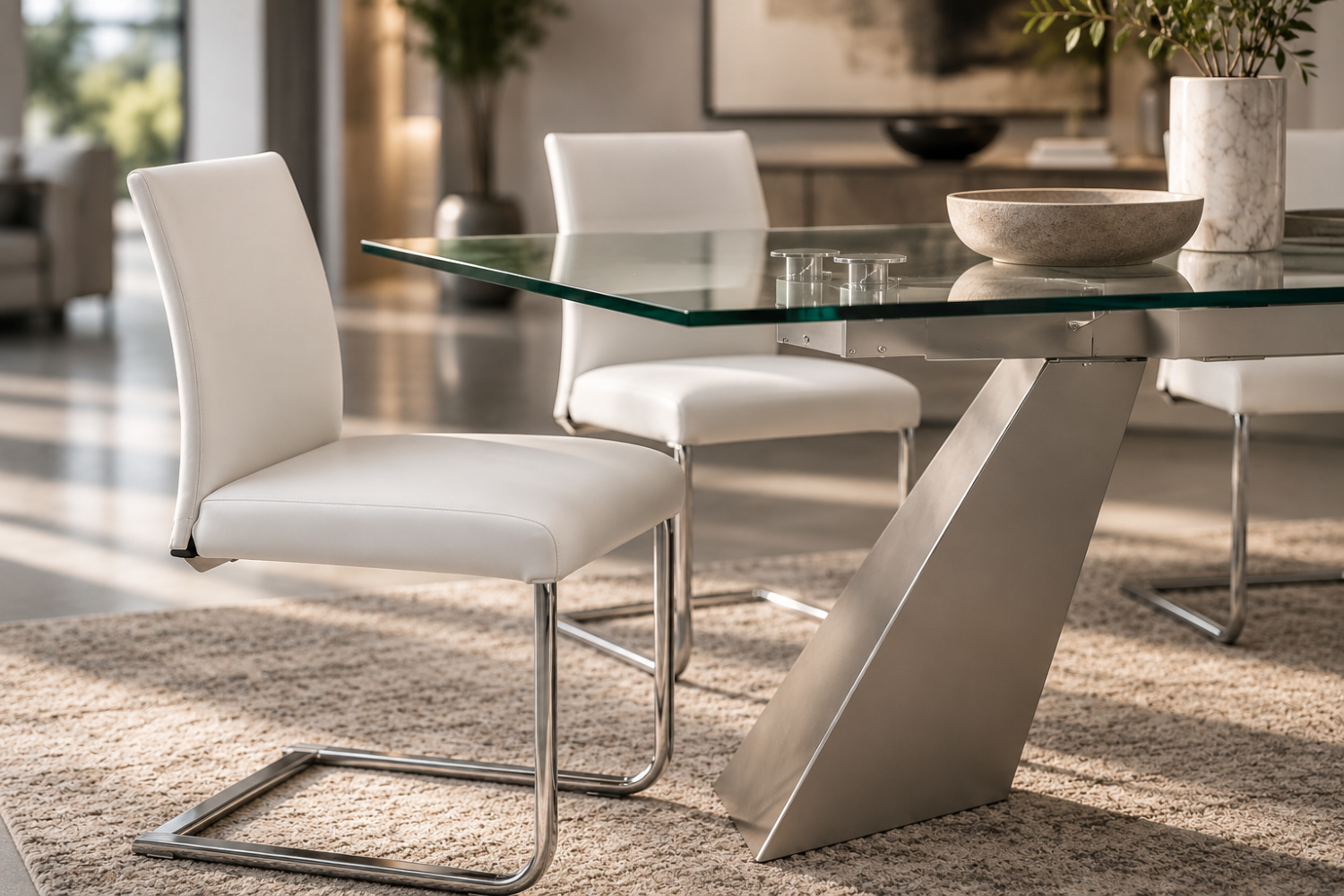
Four dining chairs can give a room a composed, versatile foundation, but the right set is determined by more than appearance. Your table's size and shape, the available circulation, the way your household sits, and how often you host affect whether the arrangement feels relaxed or crowded.
Plan your four-chair dining layout with the EuroHome design center
A dining room chairs set of 4 works well for an intentional everyday arrangement that can also support casual entertaining. Check seat height, chair width, arm clearance, upholstery, and care requirements against your table and routine. Confirm the product measurements before ordering.
European dining furniture can balance sculptural design with practical use. Begin by looking at the room and table together, then consider the occasions the chairs must serve.
A four-chair set should begin with the table it will serve, not with a finish or silhouette chosen in isolation. Look at the table's shape, material, footprint, and position in the room. A compact square or round table creates a different visual rhythm from a long rectangular design. An open-plan dining area may need a lighter profile that preserves sightlines between the dining and living zones.
Study how people move around the table before comparing chairs. Leave enough practical space for diners to pull a chair out, sit down, and move past it without turning the dining area into a bottleneck. Consider door swings, nearby cabinetry, serving paths, and the route between the kitchen and table. A chair can look beautifully proportioned on a product page yet feel imposing if the room has limited circulation.
Material sets the direction for the room. A glass tabletop can support a visually quieter chair, allowing the table's transparency to remain part of the composition. Ceramic and wood tables bring a stronger surface presence, so consider whether the chairs should echo that warmth or provide a deliberate contrast. EuroHome's Eating collection includes fixed and extendable tables in glass, ceramic, and wood, giving you several starting points for a coordinated European dining scheme. Explore the European dining furniture collection to compare the broader relationship between tables and chairs.
Check the table and chair details together. Confirm the actual table height, the chair's seat height and overall width, and whether arms or a substantial back affect clearance. Product-specific measurements matter more than a universal rule, especially when combining pieces from different collections. The individual product pages should remain the authority for dimensions, materials, care, and availability. For a concrete comparison, review the Arya Easy Dining Chair and New York Chair listings before choosing four matching seats.
Think about the four chairs in their most common setting. If they will support daily breakfasts, homework, and relaxed dinners, prioritize an arrangement that feels easy to use and leaves the room comfortable when no one is entertaining. If the set will serve a smaller household but expand around an extendable table for guests. Check how the chairs relate to the table when it is closed and extended. The table's changing footprint may alter the room's flow and the visual balance of the set.
Fixed tables can make the four-chair arrangement feel consistent and intentional. Extendable designs offer a different planning question: choose chairs that remain useful for everyday seating while allowing the table to accommodate a larger occasion when needed. This practical distinction keeps the purchase focused on how your household actually lives, rather than treating four chairs as a complete decision on their own.
Start with the dimensions of your actual table, not with a chair photograph. On each product page, record the chair's seat height, overall width, seat depth, and total height. Compare those figures with the table's height, apron, legs, and underside clearance. The goal is enough room for a relaxed seated posture without arms, knees, or chair frames colliding with the table.
Measure from the floor to the top of the seat, then consider how much clearance remains between the seat and the underside of the tabletop. An apron, drawer, pedestal, or unusually thick top can reduce usable space even when the headline table height looks compatible. If the table is extendable, check the clearance in both its closed and expanded configurations. A chair that fits four people comfortably in the everyday arrangement should still work when the table is opened for guests.
Armchairs require an additional check. Measure the height and width of the arms, and compare them with the table apron and the space beneath the top. Confirm that the chair can slide fully under the table if that is part of your room plan. Also inspect leg placement. Corner legs, central pedestals, and trestle bases can limit where chairs sit, so count usable positions rather than assuming four chairs will distribute evenly.
Use the chair's overall width when planning the set, not just the width of the cushion. Add the required space between neighboring chairs so diners can sit, stand, and turn without brushing against one another. Then map the pulled-out chair positions onto the room. Mark the table footprint with painter's tape and allow each chair to move back from it. Check the route to nearby doors, cabinets, sideboards, and walkways. A set may fit around the tabletop yet make daily circulation feel cramped.
There is no single ideal sitting posture for every user, and chairs should accommodate different users and varied postures, as Cornell's ergonomics notes explain (Cornell ergonomics guidance). Consider the tallest and shortest regular diners, how they sit during a quick meal versus a long dinner, and whether anyone needs arms or extra room to change position. If possible, test a floor sample or comparable chair. Notice whether feet can rest naturally, the back feels supported, and movement feels easy rather than forced.
Before ordering, save the measurements alongside the product page and recheck them against your table, room plan, and preferred seating arrangement. EuroHome's Eating collection includes varied European dining furniture, so the individual listing is the right place to confirm the final specifications, materials, care guidance, and availability.
The best finish is the one that supports how you actually use the room. A dining room chairs set of 4 for quiet weekday meals may feel different from one used for long dinners. Frequent guests and children moving in and out of the table also affect the choice. Start with the routine, then choose the visual balance you want around the table.
EuroHome's dining selection includes standard chairs, upholstered chairs, and bicolour upholstery options. That range creates several useful design paths without requiring every chair to look identical to the table. Product details can vary, so confirm the exact material, finish, care instructions, and availability on the individual product page.
| Approach | Everyday feel | Care considerations | Visual effect |
|---|---|---|---|
| Wood | Structured and familiar, with a clean surface for regular meals. | Confirm the approved cleaning method and finish-specific guidance. Wood furniture may also benefit from controlled indoor humidity. | Warm, architectural, and easy to coordinate with a wood, glass, or ceramic table. |
| Upholstered fabric | Offers a softer visual and tactile presence for meals that linger. | Care depends on the specific fabric. EuroHome provides expertise in performance fabrics and material-care guidance, but do not assume every upholstery has the same protection. | Inviting and layered, with room to introduce colour, texture, or a quieter neutral. |
| Leather | Smooth and substantial, often well suited to a tailored dining setting. | Verify the leather type and care instructions. Climate control is general guidance relevant to leather longevity, not a universal product guarantee. | Refined and precise, especially when paired with a minimalist table. |
| Mixed or bicolour | Balances a practical chair structure with a more expressive seat or back treatment. | Check each listed material and follow the care instructions for the most sensitive surface. | Creates considered contrast without making the dining set feel unrelated. |
For a fabric chair near a bright window, UV protection is useful general guidance because sunlight can affect fabrics over time. Placement still matters: avoid treating a broad care principle as proof of a particular chair's performance. For more detail before selecting an upholstered option, review EuroHome's guide to upholstered chair care.
Finally, consider the table finish and the atmosphere you want to create. A textured upholstered chair can soften a crisp ceramic surface, while wood or leather can reinforce a more tailored composition. The strongest choice is usually the one that feels intentional, remains comfortable through a full meal, and has care requirements you are prepared to follow.
Comfort matters most when a dining chair has to support more than a quick breakfast. Family dinners, homework, conversation, and long evenings with guests all ask for a chair that feels supportive without making one rigid posture the only option. Look for a balanced combination of seat support, back support, room to shift position, and enough clearance to sit naturally at the table.
Start with the way sitting distributes weight. Cornell's ergonomics notes explain that body weight is transferred mainly through the pelvis and surrounding soft tissue. The chair should take weight off the feet and help maintain stable posture. Poor seat design has also been associated with back complaints. These points are not a diagnosis or a promise of medical benefit, but they are useful principles when comparing dining chairs. You can read the Cornell sitting and seating notes for the full context.
There is no single ideal sitting posture for every person. A comfortable dining room chairs set of 4 should accommodate different users and allow reasonable variation throughout a meal. Consider whether the back encourages you to sit upright while still permitting small shifts. Notice whether the seat feels supportive when you move slightly forward to eat or lean back to talk.
Pay attention to your own behavior during a showroom test. Frequent fidgeting can be a sign of postural stress or discomfort. Change positions, sit for several minutes, and notice whether the chair continues to feel balanced rather than merely pleasant for the first few seconds.
Seat shape and depth should support you without pressing behind the knees or leaving you reaching forward. The back should meet you where you need support, while its contour and angle should suit the table and your preferred posture. If the chair has arms, make sure they clear the tabletop and slide comfortably beneath it. Armrests that collide with the table can make an otherwise attractive chair awkward in daily use.
Test all four chairs as a group if possible. Sit in each position, pull them in and out, and check that everyone has comparable space. A chair that works for one person may feel very different to another, so comfort is best judged in person and alongside the actual table dimensions.
A simple, consistent routine protects the finish, upholstery, and overall comfort of a dining chair set. Care should always follow the material in front of you, since a sealed wood frame, performance fabric, and leather seat each respond differently to cleaning and climate. EuroHome's material-care guidance includes performance fabrics and related furniture materials; use it as a starting point, then confirm the instructions for your exact chair.
A refined dining room rarely depends on matching every surface. The stronger approach is to create a conversation between the table and a dining room chairs set of 4, using proportion, material, and one deliberate point of contrast. Begin by identifying the table's visual weight. A substantial wood top can support chairs with a lighter frame or more tactile upholstery. A glass or ceramic surface may benefit from chairs that add warmth through wood, woven detail, or softly finished fabric.
Contrast should feel coordinated rather than accidental. Repeat one element between the pieces, such as a warm undertone, a curved profile, or a restrained black detail. Then allow another element to differ. Four chairs in the same finish can provide a calm, collected look. A two-tone upholstery choice or a distinct chair silhouette can keep the setting from feeling overly matched. EuroHome's collection includes standard, upholstered, and bicolour upholstery options, giving homeowners several ways to build that balance. Confirm the exact finish, upholstery, and care requirements on each product page before ordering.
Material changes the character of the entire arrangement. Wood brings visual warmth and a grounded, welcoming quality. Glass keeps the room feeling open and allows the chairs to become the primary sculptural element. Ceramic offers a more architectural presence, which pairs well with chairs that soften the composition through upholstery or rounded lines. EuroHome's Eating collection includes fixed and extendable tables in glass, ceramic, and wood. The best chair pairing depends on the specific table design rather than material labels alone.
Shape matters as much as finish. With a rectangular table, four chairs can frame the long sides and leave the ends open for a deliberately airy arrangement. The chairs can also create a more intimate everyday setting. Around a round or compact table, look for chair backs and arms that preserve the table's sense of openness. Check the individual dimensions and arm clearance instead of relying on a universal rule.
A fixed table can make a four-chair arrangement feel crisp and intentional for daily use. An extendable table gives the same set a flexible starting point, allowing additional seating when the occasion calls for it. Keep the everyday arrangement visually balanced, then consider how the table will look when opened. Chairs should remain attractive as a complete set, but they do not need to dictate every future seat. For more table-selection context, explore the European dining table guide.
EuroHome maintains direct relationships with Italian manufacturers and select Danish makers, supporting custom sizing and finishes when available. That expertise can be useful when the table has a distinctive scale or when a room needs a more tailored combination. The goal is not uniformity for its own sake. It is a composed set of four chairs that feels comfortable, purposeful, and ready for both an ordinary dinner and a longer evening with guests.
Once you understand the fit, comfort, and care requirements for your room, begin product discovery with a collection broad enough to support those decisions. EuroHome's dining room collection brings together Italian, European, and Contemporary dining furniture for everyday dining and entertaining. It is a useful starting point for comparing a coordinated four-chair direction with the table, materials, and atmosphere you want in the room.
Visit the EuroHome design center for help coordinating your dining seating.
The Eating collection brings together dining chairs in several design directions, including standard chairs, upholstered options, and bicolour upholstery. That range gives you room to compare four seats by their relationship to your table and daily routine rather than treating every set of four as interchangeable. Product availability and specifications can change, so use each listing to confirm the current details.
This guide is designed for the four-seat planning decision: map four positions to a real table and room, compare comfort and materials, then shortlist products. If you already know that you want beige tufting, a DSW silhouette, or a black Wishbone design, those narrower style decisions belong in focused product or style content. If your priority is finding four chairs for a particular room, table, and lifestyle, compare the relevant options side by side in the collection.
After identifying a promising design, review its product page carefully. Confirm the current seat height, overall width, arm clearance, upholstery or finish, care instructions, and availability before treating it as the right dining room chairs set of 4 for your table. Product-level details should come from the individual listing, not from assumptions based on a photograph or a similar chair.
For a more guided process, EuroHome offers design-led support from concept through white-glove installation. Its curated catalog contains more than 1,200 products, and direct relationships with European makers support design expertise and selected customization conversations. If you are furnishing within the primary 50-mile service area of King of Prussia, visit the EuroHome design center to discuss the room, table, and finish together. That extra context can make a four-chair decision feel considered rather than rushed.
Compare four-chair options in the EuroHome Eating collection
Check the table height, the chair's seat height, overall width, and any armrests together. Confirm that diners can sit comfortably without arms colliding with the tabletop or neighboring chairs. Since users vary in posture and body proportions, a flexible fit matters more than a single universal measurement. Cornell ergonomics guidance recommends accommodating different users and postures.
They can be, provided the upholstery suits your household and you follow the product's care instructions. Ask whether the fabric is designed for your level of use, how spills should be treated, and whether sunlight exposure is a concern. EuroHome provides material-care guidance and offers standard, upholstered, and bicolour upholstery options, but individual product details should be confirmed before ordering.
Armchairs can add support and a more formal presence, but they require enough clearance beneath and beside the table. Measure the arm height and width, then consider how easily each chair can slide in and out. Armless side chairs are often easier to space around a compact table or use for larger gatherings.
Review the current product page for seat height, overall dimensions, materials, finish, upholstery, care instructions, and availability. Also compare those details with your table and room circulation. Product specifications and availability can vary, so do not rely on a general category description alone.
Begin with EuroHome's European dining furniture collection, which brings together Italian, European, and Contemporary dining pieces. Use the individual product pages to compare chair details, then contact the showroom if you need help coordinating seating with a fixed or extendable table.
A well-chosen set of four can make everyday meals feel comfortable while keeping the room ready for guests. Browse the Eating collection to compare styles and consider each product's measurements, materials, care guidance, and availability. If you would like help coordinating chairs with your table and room, visit the EuroHome design center for a more focused next step.
Plan your dining seating with the EuroHome design center

Four dining chairs can give a room a composed, versatile foundation, but the right set is determined by more than appearance. Your table's size and shape, the available circulation, the way your household sits, and how often you host affect whether the arrangement feels relaxed or crowded.
Plan your four-chair dining layout with the EuroHome design center
A dining room chairs set of 4 works well for an intentional everyday arrangement that can also support casual entertaining. Check seat height, chair width, arm clearance, upholstery, and care requirements against your table and routine. Confirm the product measurements before ordering.
European dining furniture can balance sculptural design with practical use. Begin by looking at the room and table together, then consider the occasions the chairs must serve.
A four-chair set should begin with the table it will serve, not with a finish or silhouette chosen in isolation. Look at the table's shape, material, footprint, and position in the room. A compact square or round table creates a different visual rhythm from a long rectangular design. An open-plan dining area may need a lighter profile that preserves sightlines between the dining and living zones.
Study how people move around the table before comparing chairs. Leave enough practical space for diners to pull a chair out, sit down, and move past it without turning the dining area into a bottleneck. Consider door swings, nearby cabinetry, serving paths, and the route between the kitchen and table. A chair can look beautifully proportioned on a product page yet feel imposing if the room has limited circulation.
Material sets the direction for the room. A glass tabletop can support a visually quieter chair, allowing the table's transparency to remain part of the composition. Ceramic and wood tables bring a stronger surface presence, so consider whether the chairs should echo that warmth or provide a deliberate contrast. EuroHome's Eating collection includes fixed and extendable tables in glass, ceramic, and wood, giving you several starting points for a coordinated European dining scheme. Explore the European dining furniture collection to compare the broader relationship between tables and chairs.
Check the table and chair details together. Confirm the actual table height, the chair's seat height and overall width, and whether arms or a substantial back affect clearance. Product-specific measurements matter more than a universal rule, especially when combining pieces from different collections. The individual product pages should remain the authority for dimensions, materials, care, and availability. For a concrete comparison, review the Arya Easy Dining Chair and New York Chair listings before choosing four matching seats.
Think about the four chairs in their most common setting. If they will support daily breakfasts, homework, and relaxed dinners, prioritize an arrangement that feels easy to use and leaves the room comfortable when no one is entertaining. If the set will serve a smaller household but expand around an extendable table for guests. Check how the chairs relate to the table when it is closed and extended. The table's changing footprint may alter the room's flow and the visual balance of the set.
Fixed tables can make the four-chair arrangement feel consistent and intentional. Extendable designs offer a different planning question: choose chairs that remain useful for everyday seating while allowing the table to accommodate a larger occasion when needed. This practical distinction keeps the purchase focused on how your household actually lives, rather than treating four chairs as a complete decision on their own.
Start with the dimensions of your actual table, not with a chair photograph. On each product page, record the chair's seat height, overall width, seat depth, and total height. Compare those figures with the table's height, apron, legs, and underside clearance. The goal is enough room for a relaxed seated posture without arms, knees, or chair frames colliding with the table.
Measure from the floor to the top of the seat, then consider how much clearance remains between the seat and the underside of the tabletop. An apron, drawer, pedestal, or unusually thick top can reduce usable space even when the headline table height looks compatible. If the table is extendable, check the clearance in both its closed and expanded configurations. A chair that fits four people comfortably in the everyday arrangement should still work when the table is opened for guests.
Armchairs require an additional check. Measure the height and width of the arms, and compare them with the table apron and the space beneath the top. Confirm that the chair can slide fully under the table if that is part of your room plan. Also inspect leg placement. Corner legs, central pedestals, and trestle bases can limit where chairs sit, so count usable positions rather than assuming four chairs will distribute evenly.
Use the chair's overall width when planning the set, not just the width of the cushion. Add the required space between neighboring chairs so diners can sit, stand, and turn without brushing against one another. Then map the pulled-out chair positions onto the room. Mark the table footprint with painter's tape and allow each chair to move back from it. Check the route to nearby doors, cabinets, sideboards, and walkways. A set may fit around the tabletop yet make daily circulation feel cramped.
There is no single ideal sitting posture for every user, and chairs should accommodate different users and varied postures, as Cornell's ergonomics notes explain (Cornell ergonomics guidance). Consider the tallest and shortest regular diners, how they sit during a quick meal versus a long dinner, and whether anyone needs arms or extra room to change position. If possible, test a floor sample or comparable chair. Notice whether feet can rest naturally, the back feels supported, and movement feels easy rather than forced.
Before ordering, save the measurements alongside the product page and recheck them against your table, room plan, and preferred seating arrangement. EuroHome's Eating collection includes varied European dining furniture, so the individual listing is the right place to confirm the final specifications, materials, care guidance, and availability.
The best finish is the one that supports how you actually use the room. A dining room chairs set of 4 for quiet weekday meals may feel different from one used for long dinners. Frequent guests and children moving in and out of the table also affect the choice. Start with the routine, then choose the visual balance you want around the table.
EuroHome's dining selection includes standard chairs, upholstered chairs, and bicolour upholstery options. That range creates several useful design paths without requiring every chair to look identical to the table. Product details can vary, so confirm the exact material, finish, care instructions, and availability on the individual product page.
| Approach | Everyday feel | Care considerations | Visual effect |
|---|---|---|---|
| Wood | Structured and familiar, with a clean surface for regular meals. | Confirm the approved cleaning method and finish-specific guidance. Wood furniture may also benefit from controlled indoor humidity. | Warm, architectural, and easy to coordinate with a wood, glass, or ceramic table. |
| Upholstered fabric | Offers a softer visual and tactile presence for meals that linger. | Care depends on the specific fabric. EuroHome provides expertise in performance fabrics and material-care guidance, but do not assume every upholstery has the same protection. | Inviting and layered, with room to introduce colour, texture, or a quieter neutral. |
| Leather | Smooth and substantial, often well suited to a tailored dining setting. | Verify the leather type and care instructions. Climate control is general guidance relevant to leather longevity, not a universal product guarantee. | Refined and precise, especially when paired with a minimalist table. |
| Mixed or bicolour | Balances a practical chair structure with a more expressive seat or back treatment. | Check each listed material and follow the care instructions for the most sensitive surface. | Creates considered contrast without making the dining set feel unrelated. |
For a fabric chair near a bright window, UV protection is useful general guidance because sunlight can affect fabrics over time. Placement still matters: avoid treating a broad care principle as proof of a particular chair's performance. For more detail before selecting an upholstered option, review EuroHome's guide to upholstered chair care.
Finally, consider the table finish and the atmosphere you want to create. A textured upholstered chair can soften a crisp ceramic surface, while wood or leather can reinforce a more tailored composition. The strongest choice is usually the one that feels intentional, remains comfortable through a full meal, and has care requirements you are prepared to follow.
Comfort matters most when a dining chair has to support more than a quick breakfast. Family dinners, homework, conversation, and long evenings with guests all ask for a chair that feels supportive without making one rigid posture the only option. Look for a balanced combination of seat support, back support, room to shift position, and enough clearance to sit naturally at the table.
Start with the way sitting distributes weight. Cornell's ergonomics notes explain that body weight is transferred mainly through the pelvis and surrounding soft tissue. The chair should take weight off the feet and help maintain stable posture. Poor seat design has also been associated with back complaints. These points are not a diagnosis or a promise of medical benefit, but they are useful principles when comparing dining chairs. You can read the Cornell sitting and seating notes for the full context.
There is no single ideal sitting posture for every person. A comfortable dining room chairs set of 4 should accommodate different users and allow reasonable variation throughout a meal. Consider whether the back encourages you to sit upright while still permitting small shifts. Notice whether the seat feels supportive when you move slightly forward to eat or lean back to talk.
Pay attention to your own behavior during a showroom test. Frequent fidgeting can be a sign of postural stress or discomfort. Change positions, sit for several minutes, and notice whether the chair continues to feel balanced rather than merely pleasant for the first few seconds.
Seat shape and depth should support you without pressing behind the knees or leaving you reaching forward. The back should meet you where you need support, while its contour and angle should suit the table and your preferred posture. If the chair has arms, make sure they clear the tabletop and slide comfortably beneath it. Armrests that collide with the table can make an otherwise attractive chair awkward in daily use.
Test all four chairs as a group if possible. Sit in each position, pull them in and out, and check that everyone has comparable space. A chair that works for one person may feel very different to another, so comfort is best judged in person and alongside the actual table dimensions.
A simple, consistent routine protects the finish, upholstery, and overall comfort of a dining chair set. Care should always follow the material in front of you, since a sealed wood frame, performance fabric, and leather seat each respond differently to cleaning and climate. EuroHome's material-care guidance includes performance fabrics and related furniture materials; use it as a starting point, then confirm the instructions for your exact chair.
A refined dining room rarely depends on matching every surface. The stronger approach is to create a conversation between the table and a dining room chairs set of 4, using proportion, material, and one deliberate point of contrast. Begin by identifying the table's visual weight. A substantial wood top can support chairs with a lighter frame or more tactile upholstery. A glass or ceramic surface may benefit from chairs that add warmth through wood, woven detail, or softly finished fabric.
Contrast should feel coordinated rather than accidental. Repeat one element between the pieces, such as a warm undertone, a curved profile, or a restrained black detail. Then allow another element to differ. Four chairs in the same finish can provide a calm, collected look. A two-tone upholstery choice or a distinct chair silhouette can keep the setting from feeling overly matched. EuroHome's collection includes standard, upholstered, and bicolour upholstery options, giving homeowners several ways to build that balance. Confirm the exact finish, upholstery, and care requirements on each product page before ordering.
Material changes the character of the entire arrangement. Wood brings visual warmth and a grounded, welcoming quality. Glass keeps the room feeling open and allows the chairs to become the primary sculptural element. Ceramic offers a more architectural presence, which pairs well with chairs that soften the composition through upholstery or rounded lines. EuroHome's Eating collection includes fixed and extendable tables in glass, ceramic, and wood. The best chair pairing depends on the specific table design rather than material labels alone.
Shape matters as much as finish. With a rectangular table, four chairs can frame the long sides and leave the ends open for a deliberately airy arrangement. The chairs can also create a more intimate everyday setting. Around a round or compact table, look for chair backs and arms that preserve the table's sense of openness. Check the individual dimensions and arm clearance instead of relying on a universal rule.
A fixed table can make a four-chair arrangement feel crisp and intentional for daily use. An extendable table gives the same set a flexible starting point, allowing additional seating when the occasion calls for it. Keep the everyday arrangement visually balanced, then consider how the table will look when opened. Chairs should remain attractive as a complete set, but they do not need to dictate every future seat. For more table-selection context, explore the European dining table guide.
EuroHome maintains direct relationships with Italian manufacturers and select Danish makers, supporting custom sizing and finishes when available. That expertise can be useful when the table has a distinctive scale or when a room needs a more tailored combination. The goal is not uniformity for its own sake. It is a composed set of four chairs that feels comfortable, purposeful, and ready for both an ordinary dinner and a longer evening with guests.
Once you understand the fit, comfort, and care requirements for your room, begin product discovery with a collection broad enough to support those decisions. EuroHome's dining room collection brings together Italian, European, and Contemporary dining furniture for everyday dining and entertaining. It is a useful starting point for comparing a coordinated four-chair direction with the table, materials, and atmosphere you want in the room.
Visit the EuroHome design center for help coordinating your dining seating.
The Eating collection brings together dining chairs in several design directions, including standard chairs, upholstered options, and bicolour upholstery. That range gives you room to compare four seats by their relationship to your table and daily routine rather than treating every set of four as interchangeable. Product availability and specifications can change, so use each listing to confirm the current details.
This guide is designed for the four-seat planning decision: map four positions to a real table and room, compare comfort and materials, then shortlist products. If you already know that you want beige tufting, a DSW silhouette, or a black Wishbone design, those narrower style decisions belong in focused product or style content. If your priority is finding four chairs for a particular room, table, and lifestyle, compare the relevant options side by side in the collection.
After identifying a promising design, review its product page carefully. Confirm the current seat height, overall width, arm clearance, upholstery or finish, care instructions, and availability before treating it as the right dining room chairs set of 4 for your table. Product-level details should come from the individual listing, not from assumptions based on a photograph or a similar chair.
For a more guided process, EuroHome offers design-led support from concept through white-glove installation. Its curated catalog contains more than 1,200 products, and direct relationships with European makers support design expertise and selected customization conversations. If you are furnishing within the primary 50-mile service area of King of Prussia, visit the EuroHome design center to discuss the room, table, and finish together. That extra context can make a four-chair decision feel considered rather than rushed.
Compare four-chair options in the EuroHome Eating collection
Check the table height, the chair's seat height, overall width, and any armrests together. Confirm that diners can sit comfortably without arms colliding with the tabletop or neighboring chairs. Since users vary in posture and body proportions, a flexible fit matters more than a single universal measurement. Cornell ergonomics guidance recommends accommodating different users and postures.
They can be, provided the upholstery suits your household and you follow the product's care instructions. Ask whether the fabric is designed for your level of use, how spills should be treated, and whether sunlight exposure is a concern. EuroHome provides material-care guidance and offers standard, upholstered, and bicolour upholstery options, but individual product details should be confirmed before ordering.
Armchairs can add support and a more formal presence, but they require enough clearance beneath and beside the table. Measure the arm height and width, then consider how easily each chair can slide in and out. Armless side chairs are often easier to space around a compact table or use for larger gatherings.
Review the current product page for seat height, overall dimensions, materials, finish, upholstery, care instructions, and availability. Also compare those details with your table and room circulation. Product specifications and availability can vary, so do not rely on a general category description alone.
Begin with EuroHome's European dining furniture collection, which brings together Italian, European, and Contemporary dining pieces. Use the individual product pages to compare chair details, then contact the showroom if you need help coordinating seating with a fixed or extendable table.
A well-chosen set of four can make everyday meals feel comfortable while keeping the room ready for guests. Browse the Eating collection to compare styles and consider each product's measurements, materials, care guidance, and availability. If you would like help coordinating chairs with your table and room, visit the EuroHome design center for a more focused next step.
Plan your dining seating with the EuroHome design center


