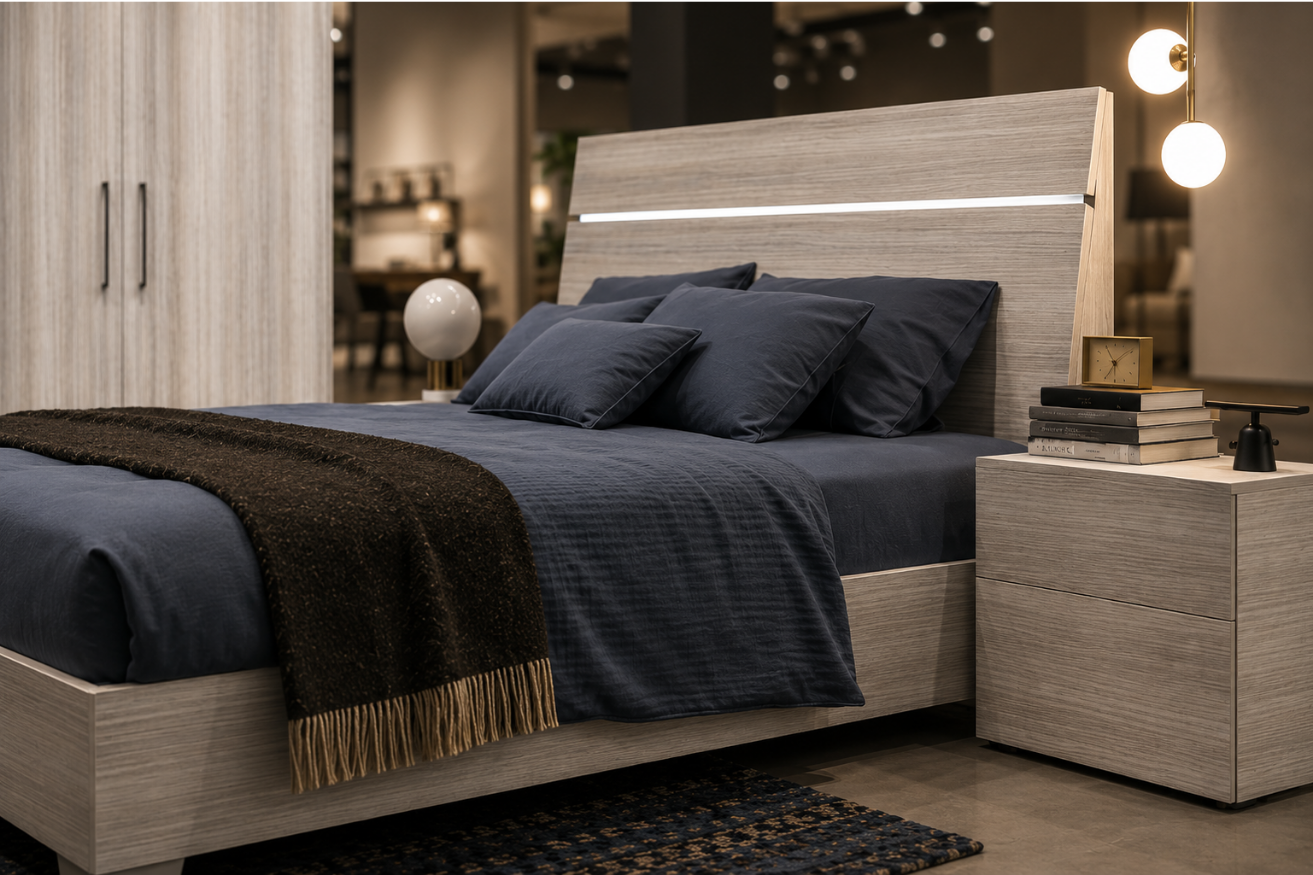
A beautiful room can still feel unresolved when scale, comfort, finishes, and installation are treated as separate decisions. That is the central difference to consider when comparing digital design help with a studio that can guide the project in person.
Explore EuroHome's personalized interior design services to discuss your room with the design team.
Online interior design can provide convenient style direction, layouts, visual concepts, and product recommendations from a distance. A full-service European design studio adds physical material review, curated selections, manufacturer relationships, coordination, and installation support. This makes it better suited to homeowners who want one connected design process.
Neither approach is automatically right for every room. The best choice depends on how much responsibility you want to retain, how complex the space is, and whether seeing materials in context matters to you. Understanding what the digital process actually includes is the right place to begin.
Online interior design typically turns a room project into a structured digital exchange. Instead of meeting a designer in the space, you share your goals, dimensions, photographs, and preferences remotely. The designer then develops a concept and recommends products that you can review and purchase yourself. The format is convenient and can fit around your schedule, but the exact deliverables vary by provider, package, and project scope.
A typical workflow looks like this:
For a contained refresh and a confident shopper, this process can be an efficient way to gain professional direction. A larger or more complex project may require a service that stays involved beyond the digital plan. particularly when selections. Vendors, delivery, and installation need to work as one coordinated effort.
A full-service studio begins before product selection. Discovery clarifies how you live, what the room must support, and which decisions matter most. The conversation may include daily routines, entertaining, comfort, storage, architectural constraints, and the atmosphere you want to create. That context gives the design direction a practical foundation instead of treating each furniture purchase as an isolated choice.
From there, space planning connects the room's proportions, circulation, focal points, and functional needs. A designer considers how pieces relate to one another, not only whether each item looks appealing in a browser window. This broader view can reveal when a layout needs fewer pieces, a different scale, or a more useful balance between open space and furnishing.
Selection is another important difference. Rather than sending you into an unlimited catalog, a studio narrows the field to a small group of best-fit options based on the brief. EuroHome's approach is to present two or three considered design directions, helping clients compare quality. Materials, comfort, and European design character without losing sight of the room as a whole. Italian and Scandinavian influences can then be combined intentionally, with finishes and silhouettes chosen to feel cohesive rather than collected at random.
A full-service scope also extends beyond recommendations. Procurement coordination helps organize the practical details involved in moving from a design decision to an actual project. That can include communication around selected products, order information, vendor relationships, and the dependencies that affect the next stage. Product availability, lead times, and delivery considerations vary by item, location, and project, so active coordination is more useful than assuming every purchase follows the same path.
Project management keeps design intent connected to execution. The studio can track the moving parts, communicate progress, and coordinate the sequence between sourcing, delivery, and the room's final setup. This is especially valuable when a furnishing project involves multiple pieces or requires interaction with other professionals and site conditions.
Finally, white-glove installation completes the physical side of the experience. Furniture is not simply left at the door for the homeowner to assemble into a finished composition. Placement, handling, and final presentation are treated as part of the design service. To explore how this integrated approach works in person, visit the personalized interior design services at EuroHome's design center.
The right choice depends less on whether you prefer digital or in-person communication and more on how much responsibility you want to retain. Online interior design can be a practical fit for a contained refresh. Especially when you are comfortable measuring the room, reviewing concepts on screen, sourcing products, and managing delivery yourself. It offers convenience and lets you make decisions around your own schedule.
Full-service design becomes more valuable as the project grows in complexity. A whole-home furnishing plan, a room with unusual proportions, or a residence requiring coordinated deliveries involves decisions that extend beyond selecting attractive pieces. Space planning, lighting, finishes, product availability, vendor communication, and installation sequencing all affect the finished result. Full-service studios can manage those connected details as one project rather than leaving the homeowner to join the pieces.
| Consideration | Online interior design | Full-service design |
|---|---|---|
| Remote convenience | Digital communication and materials review from home, often on the client's schedule. | Personal consultations and direct interaction, with in-person decisions where useful. |
| Physical material review | Finish and fabric choices are generally evaluated through digital images or shipped samples, depending on the service. | Physical finishes, textures, scale, and comfort can be considered alongside the room. |
| Scope | Usually centered on advice, concepts, selections, or a defined room. | Can extend from discovery and space planning through furnishing and installation. |
| Coordination | The homeowner typically coordinates vendors, deliveries, and decisions outside the design package. | The studio can coordinate the connected parts of the design and procurement process. |
| Purchasing | The client commonly purchases items directly from recommended sources. | The design partner can guide or manage purchasing through curated manufacturer relationships. |
| Installation | Delivery and placement are generally handled by the client or separate providers. | Installation may be included in an end-to-end service, including white-glove installation where offered. |
There is also a difference in how design confidence is built. Digital tools can make layouts and furniture ideas easier to understand. But screens cannot fully communicate every tactile quality or reveal how a finish responds to the home's actual light. Natural light influences mood and circadian rhythms, while thoughtful furniture selection affects posture, comfort, and musculoskeletal health, according to research from Ohio University. Those considerations are easier to assess when the design conversation includes the physical environment.
Choose online service when flexibility and a clearly bounded scope matter most, and you are prepared to own the execution. Choose full-service support when you want a cohesive plan, curated decisions, and professional coordination from concept through completion. For an affluent homeowner investing in a lasting residence, the distinction is not simply convenience versus luxury. It is how much project oversight, physical evaluation, and implementation responsibility you want your design partner to carry.
A strong visual concept can make a design feel understandable before any furniture is ordered. Three-dimensional views help homeowners assess proportion, see how major pieces relate to one another. And identify layout problems that may be difficult to spot in a floor plan or a collection of product photographs. They can also make decisions more confident by showing the intended relationship between seating, tables, lighting, and circulation.
That clarity is especially valuable when a room has competing demands. A living room may need to support conversation, entertaining, reading, and comfortable daily use. A visual study can reveal whether a sofa overwhelms the space, whether a walkway feels cramped, or whether the arrangement leaves enough room to move naturally. It gives the design discussion a shared reference point instead of asking everyone to imagine the finished room independently.
Still, a screen cannot communicate every quality that determines whether a room feels right. Digital visuals may suggest color and shape, but they do not reproduce the exact hand of a fabric. The sheen of a finish, the weight of a stone surface, or the way upholstery responds when someone sits down. A material that looks elegant on a monitor may feel too slick, too delicate, or less comfortable than expected in person. Viewing physical samples and considering how materials interact with light, touch, and everyday use adds evidence that a rendering cannot supply.
Comfort and ergonomics also require more than visual proportion. Furniture selection affects posture and musculoskeletal health, and proper support and adjustability can make a meaningful difference in how a space is used. The Ohio University discussion of interior design and well-being identifies furniture support and adjustability as important considerations for comfort and physical health: read the research on furniture and well-being.
Lighting is another real-world variable. A room can appear balanced in a rendered scene yet feel different as daylight changes throughout the day. Natural light influences alertness and mood, while material choices also carry environmental and indoor-health considerations. Sustainable design principles address environmental responsibility and healthier, more resource-efficient spaces, so the evaluation should include finishes and their practical context, not just their appearance. For that reason, the most useful role of 3D visualization is to support a broader design process. It improves communication and helps test a direction, while physical review, comfort checks, circulation planning, and thoughtful material selection determine whether the concept works in daily life.
A room feels considered when its pieces work together beyond a shared color. Scale, proportion, materials, comfort, and daily function all need to support the way the space is used. That is the difference between collecting attractive products and shaping an interior with a clear point of view.
Online design services can make early selection convenient. Many use interactive tools to help homeowners visualize furniture and decor before purchasing, while the digital format allows decisions to happen around the client's schedule. Those strengths are useful for a focused refresh or for someone who already understands the room's dimensions, needs, and preferred aesthetic. But a screen can also encourage isolated choices. A sofa may look appealing on its own, yet feel too visually heavy beside a dining table. Too low for the surrounding case goods, or poorly suited to the circulation path.
A cohesive plan considers the room as a complete composition. Designers look at the relationship between major pieces, the amount of open space around them, and the sightlines from one area to another. Material choices then add depth. Smooth wood, textured upholstery, metal, stone, and glass can create contrast without making the room feel disjointed. Repeating a finish or a subtle tonal family across several pieces helps the eye move through the space naturally.
Comfort and function are equally important. Seating should support the room's actual routines, whether that means conversation, reading, entertaining, or quiet evenings. Ergonomic considerations can reduce physical strain and improve comfort, so selection should account for support. Dimensions, and how people will use each piece rather than relying on appearance alone. Research from Ohio University notes that furniture offering proper support and adjustability can affect posture and musculoskeletal health: ergonomic furniture selection.
European design language often depends on restraint, quality of line, and a thoughtful balance between warmth and modernity. EuroHome pairs design-studio expertise with curated Italian and Scandinavian collections, supported by direct-import relationships with those manufacturers. The result is a more focused path through materials, silhouettes, and finishes than endless browsing across unrelated catalogs.
To simplify decisions, EuroHome presents two or three best-fit options rather than overwhelming clients with every possible alternative. Each option can be evaluated against the room's scale, comfort requirements, practical use, and existing pieces. That focused curation leaves room for personal preference while keeping the larger composition intact.
The right design service depends less on whether it looks modern or traditional and more on what your project needs from start to finish. Before choosing between online interior design and an in-person studio, ask the following questions.
Will the service address one room, or can it support a broader furnishing and design plan? Clarify whether the work includes space planning, furniture selection, lighting, material guidance, and the practical details that connect one room to the next. Online services may be well suited to focused style advice or a quick update, while a full-service studio can be structured around a more comprehensive project.
Ask how consultations, measurements, design presentations, questions, and revisions will be handled. A digital process may offer useful scheduling flexibility, especially if you prefer to review concepts remotely and make purchases at your own pace. If you value seeing materials in person or discussing proportions face to face, confirm that the service includes an appropriate showroom or studio experience.
Find out whether you receive a shopping list to purchase independently, or whether the design team coordinates product sourcing and ordering. For a European-focused project, ask where the furnishings come from and how the studio evaluates quality, finish, scale, and compatibility. Direct-import relationships with Italian and Scandinavian manufacturers can be relevant when you want access to pieces beyond the most familiar online catalogues.
Furniture selection is only one part of a larger project. Ask who coordinates vendors, delivery details, contractors, and installation, and whether those responsibilities remain with you. Full-service design can include comprehensive project management, from space planning through white-glove installation, but the exact scope should be confirmed before work begins. EuroHome's full-service European design studio guide offers additional context for homeowners considering a local, integrated approach.
Ask how many rounds of feedback are part of the service, when changes must be requested, and whether revisions cover the overall plan or only individual products. Clear expectations help you compare services fairly and avoid choosing a model that does not match your decision-making style.
For a remote refresh, location may matter less. For a whole-home furnishing project, custom pieces, material review, coordination, or installation, proximity can make in-person collaboration more practical. Confirm the service area and which parts of the process can happen on site before committing.
Schedule a design consultation with EuroHome to compare the right level of support for your project.
You typically share room measurements, photographs, preferences, and goals through a digital platform or consultation. The designer then develops a layout, visual concepts, and product recommendations for your review. Depending on the service, you may handle purchasing and implementation yourself, so confirm exactly what the package includes before beginning.
It can be a practical choice for a focused room refresh, a second home, or a homeowner who is comfortable coordinating purchases and installation. A full-service studio may be the better fit when the project involves several rooms, custom sourcing, complex logistics, or a strong preference for in-person guidance and accountability. The right choice depends on scope, involvement, and desired level of service.
Many online services offer digital visualization, including 3D renderings or interactive room concepts. These tools can clarify proportion, furniture placement, and overall direction. They do not always replace viewing real finishes, assessing comfort, or confirming how materials and colors respond to the actual light in your home.
There is no single standard price. Fees vary according to the designer, project scope, number of rooms, deliverables, revisions, and whether purchasing or implementation support is included. Request a detailed explanation of what you receive, and evaluate the total service model rather than comparing a digital design fee with a full-service project as if they were equivalent.
Online interior design is primarily remote and typically centers on digital concepts, recommendations, and client-led execution. A traditional or full-service studio can add physical material review, curated sourcing, procurement coordination, project management, and installation support. For homeowners seeking a cohesive result with fewer logistical responsibilities, that hands-on scope can be a meaningful distinction.
The best approach depends on how much guidance, coordination, and hands-on support your home project requires. A conversation with EuroHome can help clarify which path fits your goals, from focused online input to a more integrated studio experience. To speak with the team about your home and next project, schedule a design consultation.

