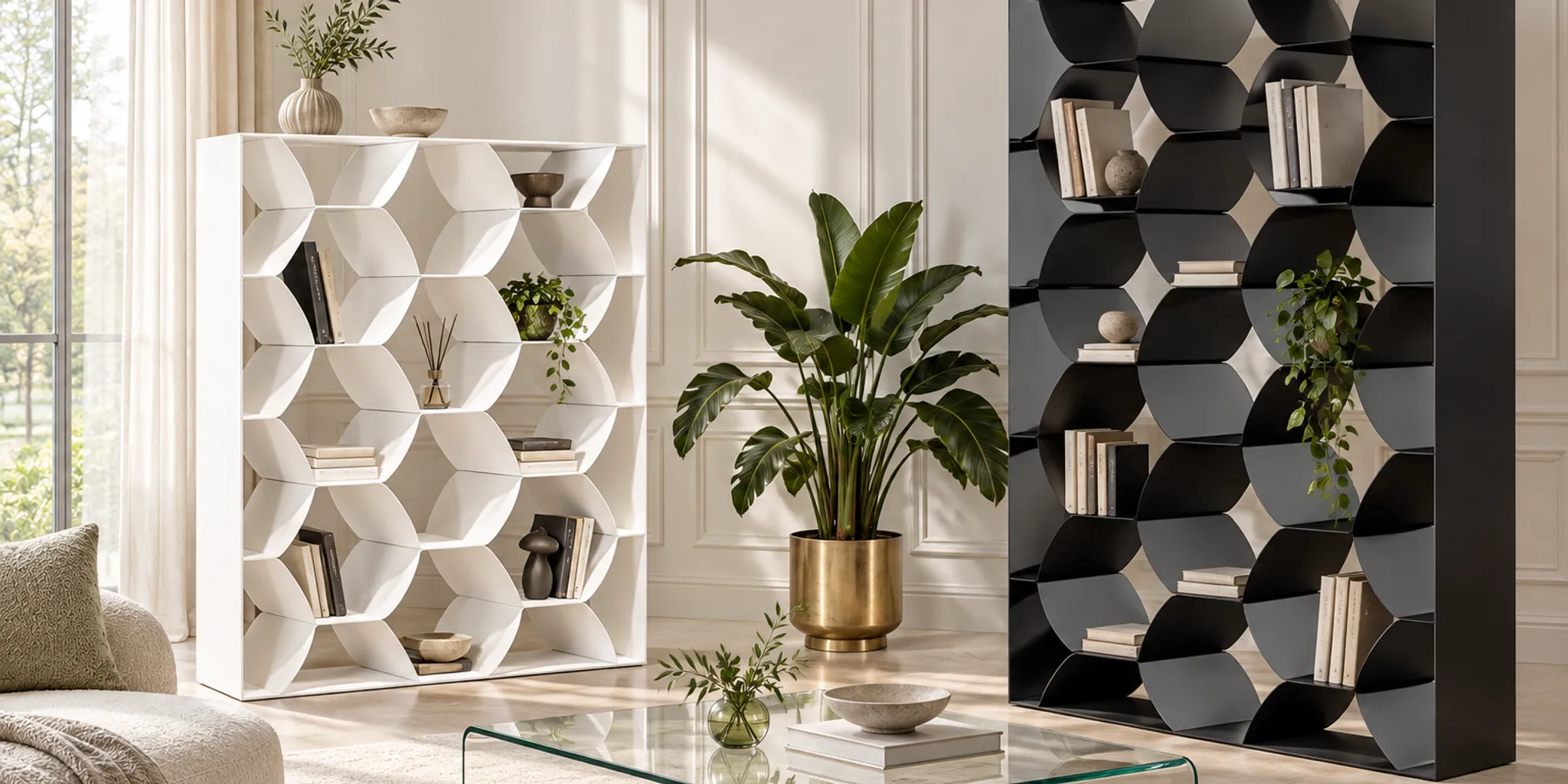
A modern bookcase is a storage decision before it is a style decision. Depth, wall construction, and how you load the shelves decide whether the piece feels calm or crowds the room. EuroHome's living collection currently lists 15 bookcases, and the category filter marks every one Made to Order, from a shallow wall shelf to a floor-standing tower. This guide covers the buying checks. Styling a shelf you already own is a separate job, and so is shopping the product grid itself.
Book a design consultation to match a bookcase to your wall, ceiling, and daily storage.
Shoppers searching for a modern bookcase usually want three things at once. They want books and objects off the floor. They want a clean silhouette that still works in a traditional house. They want the piece to stay put once it is full.
Those jobs are not the same as decorating a shelf you already own. They are also not the same as buying a media wall. A bookcase holds books and objects. A wall unit built for a television needs different depth, ventilation, and cable space.
Start with a short list of what must live on the piece:
If the list is mostly books, a bookcase is the right category. If the list is mostly a television, speakers, and hidden components, look at an entertainment wall instead. EuroHome's Italian entertainment center guide covers that separate decision.
Depth is the check most people skip. A shelf can look generous in a wide photo and still be too shallow for the books you own. Match the deepest book you actually own to a published shelf depth before you fall for a shape.
Use these working ranges:
Published depths in the current collection land in different ranges. The Pangean bookcase, at 9 3/4 inches deep, sits in the first range. The Naviglia bookcase, at 13 3/4 inches deep, sits in the hardcover range. Castella, at 16 1/4 inches deep, can take larger books in both its 37 1/2 inch and 70 3/4 inch heights. The Oasia bookshelf, at 26 3/4 inches deep, is a floor sculpture as much as a shelf. Put it where people do not need to pass close behind a chair.
Also check shelf opening height, not only case height. Oversized design books often need 13 to 15 inches of clear opening. If the maker does not publish that opening, ask before you order. Returning a custom case is harder than confirming one number.
European pieces in this collection are often sculptural. Naviglia uses angled lines across a 47 1/4 inch width. The Castella bookcase stacks geometric frames like a house of cards. Both look light in a photo. Both still occupy real floor and wall.
Measure in this order:
Oasia is a useful test of this method. It is 26 3/4 inches wide, 26 3/4 inches deep, and 80 3/4 inches tall, with seven round shelves inside a metal frame. The footprint is compact in width and generous in depth. It suits an open corner better than a narrow hall.
The Osunara bookcase is the opposite proportion. It is 14 1/4 inches wide, 18 inches deep, and 76 3/4 inches tall. Use it when you need height without a wide run of cabinetry.
EuroHome's bookcase filters split the current collection into wall-mounted and freestanding pieces. That split matters more than the finish, because it changes who installs the piece and what the wall has to hold.
| Type | What it asks of the room | A published size in the collection | Choose it when |
|---|---|---|---|
| Shallow wall shelf | Studs or solid masonry, and a clear wall above the baseboard. | Vilia shelf, 11 3/4 in. wide and 10 1/4 in. deep. | You need one display niche, not a library. |
| A wider wall-mounted bookcase | A level mount and hardware rated for the loaded weight. | Pangean bookcase, 29 1/2 in. wide and 9 3/4 in. deep. | You want books on the wall and no floor footprint. |
| A low freestanding case | Floor space and a stable, level surface. | Castella short, 55 in. wide and 37 1/2 in. tall. | The piece sits under art or beside a sofa. |
| A tall freestanding case | Ceiling clearance plus an anchor to the wall. | Castella tall, 55 in. wide and 70 3/4 in. tall. | You want a library wall and can secure the top. |
The Vilia shelf is a single geometric niche, 11 3/4 inches in each main dimension and 10 1/4 inches deep. It is a display perch, not a place for a full shelf of art books. Pangean is still shallow, at 9 3/4 inches deep, but it is wide enough for a short row of books. Confirm paperback thickness before you assume a deep hardcover will sit flush.
Freestanding does not mean unsecured. A tall case can tip if it is top-heavy or if someone climbs it. The U.S. Consumer Product Safety Commission tells households to anchor top-heavy furniture and to follow the maker's instructions. Its Anchor It campaign is the public safety reference to read before a tall bookcase goes against a wall where children live or visit.
Ask the installer what the wall is made of, and whether the supplied hardware matches that wall. Plaster over wood studs, masonry, and metal studs do not take the same anchor. If you want a full built-in run rather than one case, the custom living room shelving guide is the better next read.
The right modern bookcase in the wrong spot still fails. Walk the room before you commit to a width. A case beside a sofa should not block the path to a door. A case behind a sofa should stay lower than the back line, or it will read as a second wall. A case in a dining room should clear chair backs when someone stands up.
Living rooms are the usual home for this piece. The living collection is where the bookcases sit next to seating, which is useful context. A 55-inch Castella can balance a three-seat sofa. A 14-inch Osunara will look lost on a long wall and right in a narrow return. Match the width to the furniture it faces, not to the largest empty surface you can find.
Home offices are the other honest use. A working office needs reach, not a display that starts above your head. Keep daily files and the books you open every week between about 24 and 60 inches from the floor. Use the top shelf for objects you rarely move. If the office also holds a printer, paper, and cables, an open bookcase will look unfinished. That is a cue for closed storage, not for more open shelves.
Halls and landings are where depth causes the most trouble. A 10-inch wall shelf can still work. An 18-inch freestanding case often cannot, because two people need to pass. Measure the clear width with the piece in place, not the width of the empty hall. If that clear width drops below a comfortable walk, choose the wall-mounted option or skip the hall.
Use one pass through these questions before you add a bookcase to an order. The answers should fit on a note. If they do not, you are still choosing a shape, not a piece that will work.
On the bookcase category page checked for this guide, listed prices run from the Vilia shelf at $524 to the Zelario bookcase at $6,422.64. Caspar is listed at $6,000, and several other tall cases sit above that. Treat those figures as the current published range, not a quote. A made-to-order finish or a different configuration can change the number, and a design consultation is the right place to confirm it. Financing, if you want it, lives on the finance page, not in this guide.
Bring a phone photo of the wall, a width, a ceiling height, and one book you actually own. Those four things settle more arguments than another hour of browsing. The showroom can then tell you whether a published size fits, or whether the wall wants a different proportion.
The bookcase category filter currently shows 15 pieces under Made to Order and none under another availability. That is a reason to decide the finish with the rest of the room, not after the seating arrives. It is not a promise that every future piece, or every configuration, will stay made to order. Confirm the product page before you order.
Wood reads warm against a traditional plaster wall. Metal and open frames read lighter and show more of the wall behind them. A glass or lacquer front will reflect windows, so place it where the glare is acceptable.
Made to order also means the calendar matters. Confirm the lead time, the delivery path, and who anchors a tall piece before you schedule painters or a move-in. EuroHome's shipping and delivery page is the place to check how a large case gets into the house. If you want the bookcase planned with the sofa, the rug, and the lighting, start at the Design Center rather than ordering one product in isolation.
A modern bookcase can sit comfortably in a house that is not a glass loft. The trick is proportion. A low, wide case under a painting keeps the older architecture in charge. A tall, narrow case in a leftover corner adds storage without pretending to be a built-in. Either one can carry a European line and still feel like it belongs with existing millwork.
Finish is a room decision, not a swatch decision. Repeat a wood tone that already appears in the floor or a nearby table. Repeat a metal only if the lamps or table bases already use it. A finish that appears once makes the bookcase look like it arrived from a different house.
Weight belongs in the same conversation. A tall open frame can look light and still be heavy once the shelves hold art books. Ask for the packed weight before delivery day. A walk-up, a tight landing, or a low doorway can rule out a one-piece case even when the wall itself is wide enough. Two smaller cases side by side are sometimes the honest answer.
Load the bottom first when you picture the piece in use. Heavy books stay low, and lighter objects sit higher. That habit keeps a tall case calmer, and it tells you whether you need the tall version at all. If most of what you own sits below eye line, the shorter Castella, or a wide low case under existing art, may be the better buy.
Browse the bookcase collection once you know the depth and the wall type you need.
In shopping, the words overlap. Use bookcase when you are choosing a case with shelves, and bookshelf when you are talking about the shelf surface itself. For styling shelves you already own, use the European bookshelf ideas guide. This page stops at the buying decision.
Not on every wall. A wall-mounted piece needs a structure that can hold the loaded weight, and hardware matched to that structure. A shallow shelf such as Vilia is still a mounted object. If you cannot find studs or solid masonry, choose a freestanding case and anchor it.
There is no universal number. Compare the piece with your ceiling and with the line of nearby doors and art. Oasia at 80 3/4 inches is a near-ceiling presence in many rooms. Castella's taller version at 70 3/4 inches leaves more air above it. Leave a planned gap, and anchor anything tall.
Do not force a bookcase to be a media unit. Television furniture needs a surface rated for the screen, a plan for cables, and ventilation. Use a bookcase for books and objects. Use a wall unit when the screen is the point.
You can order from a published size when the wall is simple and the depth already matches your books. Use a consultation when the case must align with seating, when you are choosing between several finishes, or when a tall piece needs a confirmed anchor plan. The showroom in King of Prussia can look at the wall with you.


