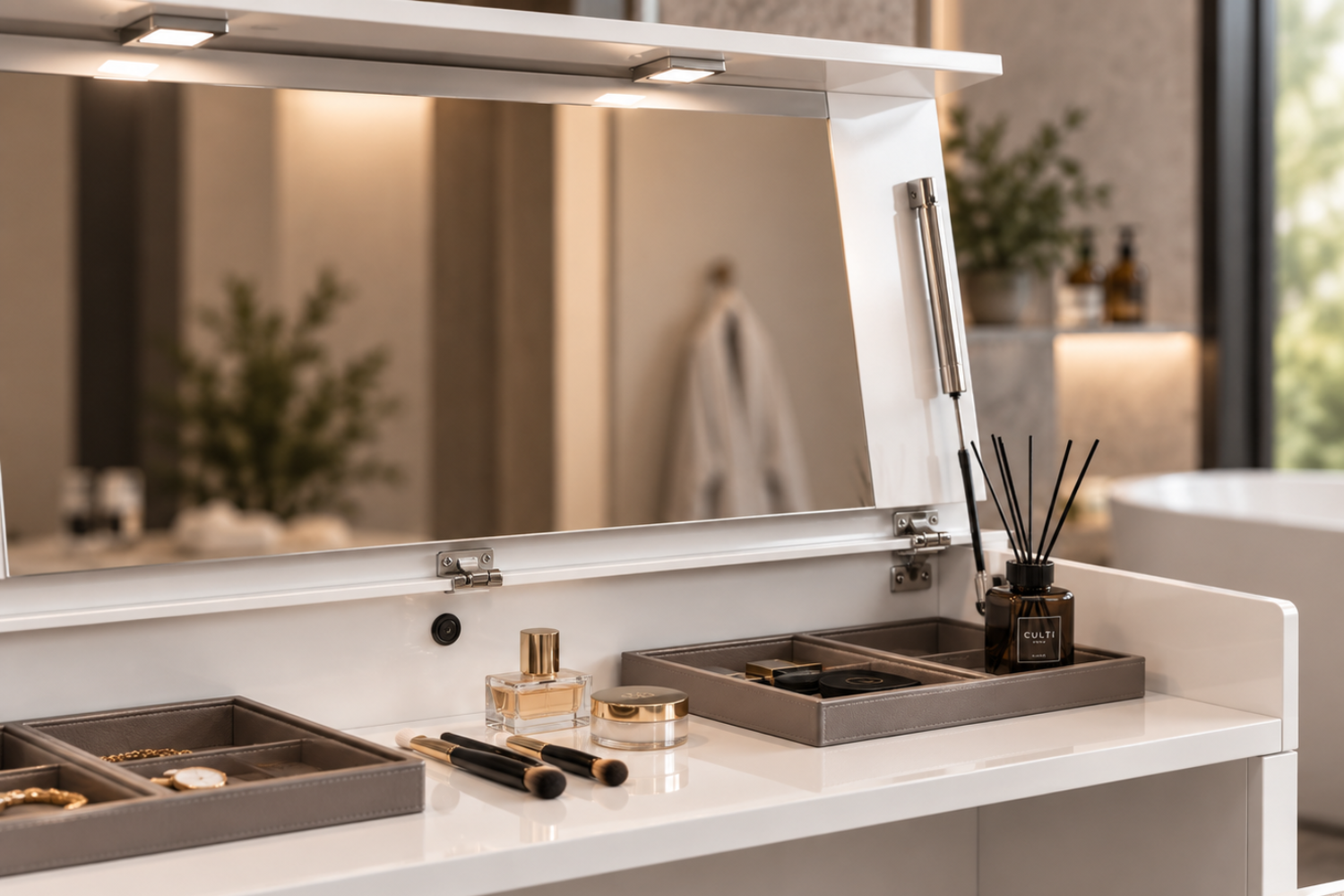
A floating bathroom vanity can make a bath feel lighter, cleaner, and more intentional, but the best choice is not made from a finish sample alone. Wall support, plumbing, countertop height, open floor clearance, and drawer access all need to work together. Use this guide to choose a wall-mounted vanity that looks refined and functions well every day.
Talk with EuroHome about your bathroom furniture plan
A floating bathroom vanity is a sink cabinet secured to the wall instead of resting on legs or a continuous base. The open area below creates a cleaner visual line and leaves more of the floor visible. The cabinet still has to carry the combined load of its structure, countertop, sink, hardware, and stored items, so the floating appearance depends on careful support rather than a lighter construction.
Think of it as a coordinated wall system. The vanity, sink, faucet, mirror, lighting, and plumbing should be planned as one composition. The goal is not simply to suspend a cabinet. It is to create a comfortable working height with storage that remains easy to reach.
A wall-mounted vanity can be useful when you want a modern architectural look and a more open relationship between furniture and floor. It is especially effective in a compact room, where a visible strip of floor can make the cabinet feel less heavy. The benefits are real, but they should be weighed against installation and planning requirements.
A floating design does not automatically create more storage or more usable room. The cabinet may be the same width and depth as a floor-mounted model. The advantage is visual openness and placement flexibility, not a promise that every bathroom will gain floor area.
Before comparing finishes, confirm the construction behind the finished wall. A floating bathroom vanity should be attached to structural support, such as wall studs or correctly installed blocking. The mounting rail, fasteners, and support requirements vary by product, so use the manufacturer's installation guide rather than a generic anchor solution.
For a useful example of the information to verify, Kohler's wall-mount vanity installation instructions address stud framing, support behind the finished wall, alignment, and plumbing planning. The guide also warns against treating the cabinet as a surface for sitting or standing. That kind of product-specific instruction should shape the rough-in plan.
Do not make drywall anchors the primary support for a vanity, countertop, or sink assembly. If the wall condition is uncertain, pause the selection and have a qualified installer confirm the support strategy before ordering.
A floating vanity exposes the area below the cabinet, so plumbing decisions affect both function and appearance. The drain and water supplies need to meet the sink and faucet layout while leaving enough room for drawers, doors, shelves, and the cabinet back. A beautiful front can become frustrating when a drawer hits a trap or a shut-off valve occupies the best storage zone.
Large single-basin and double-sink vanities can require different drain positions. Do not assume that one rough-in layout fits every width. The vanity specification sheet, sink dimensions, faucet choice, and local plumbing requirements should be reviewed together.
Bring your measurements to EuroHome's design center before you finalize the layout
Proportion is the decision that connects comfort, storage, and visual balance. Choose the finished countertop height first, then work backward through the cabinet height, sink depth, and open floor clearance. The correct result depends on the people using the bath and the exact sink and countertop assembly, so treat standard dimensions as starting points rather than guarantees.
| Dimension to check | What it controls | Selection question |
|---|---|---|
| Overall width | Sink count, counter space, wall balance | Does the vanity fit the wall without crowding doors, trim, or adjacent fixtures? |
| Cabinet depth | Reach, circulation, drawer travel | Can users stand comfortably without narrowing the path through the room? |
| Finished counter height | Daily comfort and mirror relationship | Does the cabinet, sink, and top create a comfortable hand-washing height? |
| Open clearance below | Visual lightness and cleaning access | Does the space below support the intended look without exposing services? |
| Mirror and light zone | Composition and usability | Can the mirror and lighting sit comfortably above the selected top? |
As one manufacturer reference point, Kohler lists a recommended height of 34 1/2 inches for a specific wall-mount vanity. That is not a universal rule. Sink style, countertop thickness, household height, accessibility needs, and the product's instructions can change the final measurement.
If accessibility is part of the project, use the applicable standards and professional guidance rather than relying on a general design article. The U.S. Access Board guide to lavatories and sinks covers clear floor space, lavatory height, faucets, and protection of exposed plumbing for covered accessible facilities.
Start with the routines the vanity must support, not the number of drawers shown in a product photograph. A compact wall-mounted vanity can work well when it stores daily essentials and the room has another location for backup supplies. A larger household may need more width, deeper compartments, or a companion cabinet rather than forcing every item into the sink base.
Drawers often make small items easier to see, but plumbing can reduce the usable volume of the upper drawer. Doors may provide more flexible depth, while a shallow drawer stack can improve access to daily products. Open shelving below can look light, yet it requires disciplined storage and exposes contents to view.
For complementary pieces, EuroHome's Beautify collection is the closest verified category path for decorative elements. The site does not have a dedicated bathroom hub, so do not assume that a broad category page contains bathroom vanities. Verify each product's intended use and dimensions before linking or ordering.
In a bathroom, material selection should address moisture, cleaning, touch points, and the visual relationship between the cabinet and the room. Compare the full assembly, including cabinet finish, countertop, sink, hardware, and edge treatment. A surface that looks dramatic in a sample may feel too busy when paired with strong tile or a sculptural mirror.
EuroHome's mirror collection can help with the companion piece above a vanity, but a mirror page is not a vanity category. Match the mirror's width and shape to the vanity and keep enough room for lighting, faucet clearance, and comfortable use.
Use this final checklist before a floating bathroom vanity becomes a construction or delivery decision. The best time to discover a support mismatch or drawer conflict is before the product is ordered and the wall is finished.
Visit the EuroHome design center to review a complete furniture plan
A floating bathroom vanity can be a strong choice when the wall can support the cabinet and the plumbing is planned for the unit. It creates visible floor space, simplifies cleaning underneath, and gives you control over the cabinet height.
The right clearance depends on the vanity height, countertop, sink, users, and room layout. Begin with the manufacturer's recommended finished counter height, then confirm that the open space below works with the plumbing, storage depth, and cleaning tools.
A wall-mounted vanity must be fastened to suitable structural support, usually wall studs or properly installed blocking. Drywall alone is not a reliable anchor for the cabinet and countertop assembly.
Use drawers for daily items and shallow organizers, while doors or deeper compartments can hold backup toiletries, cleaning supplies, and less frequently used products. Plan around the sink and drain so the available storage is usable, not just large on paper.
A well-proportioned floating bathroom vanity is a structural and storage decision as much as a style decision. Confirm the wall, rough-in, height, clearances, and daily routines first. Then choose the finish and companion pieces that make the room feel calm, considered, and genuinely easy to use.

