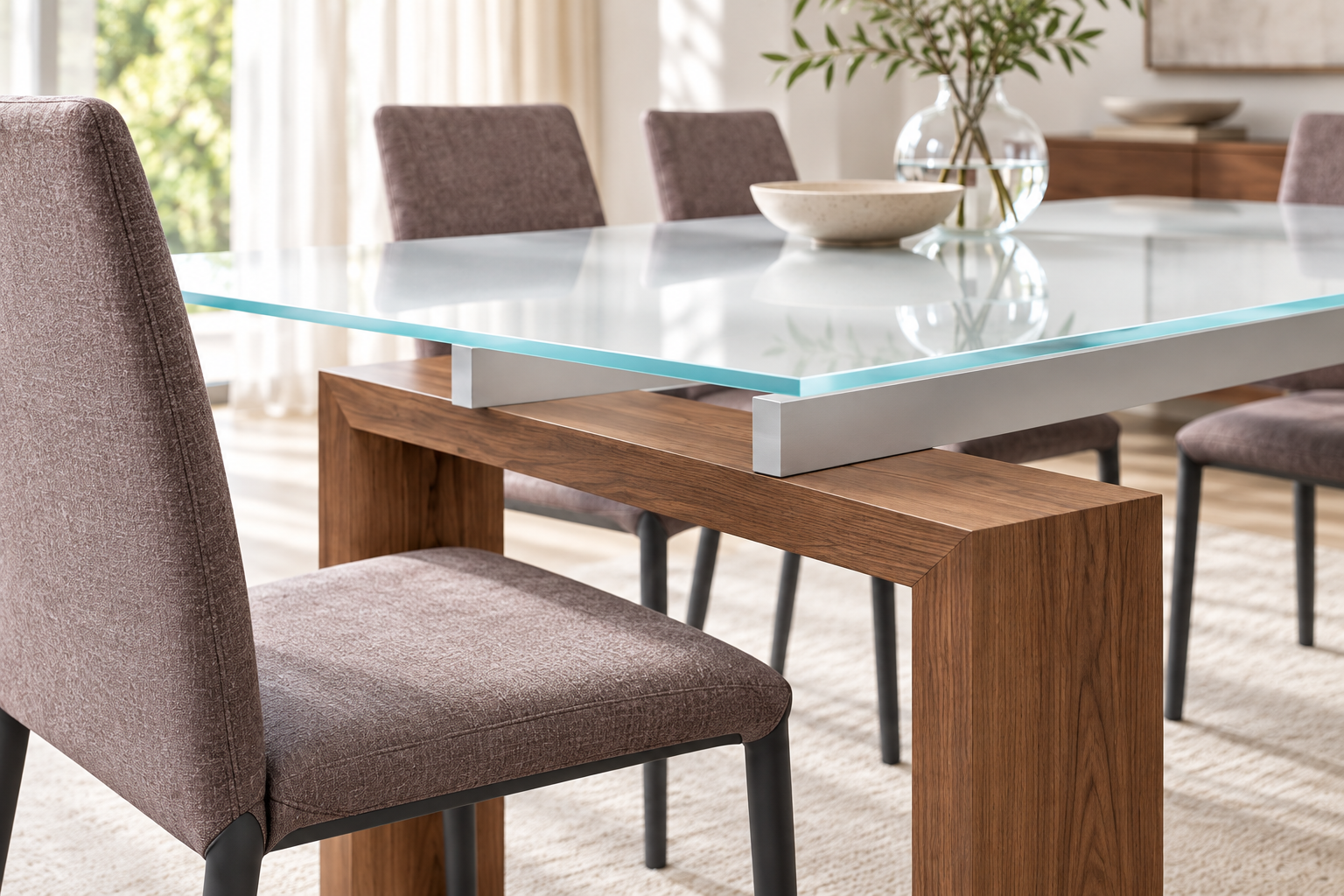
The best dining table and chairs feel settled before anyone sits down. The top leaves room to pass a dish, each chair slides under the apron, and the finishes agree without looking copied. Proportion does that work, not a matching label on the set.
Plan the set with EuroHome: Book a design consultation to compare table size, chair comfort, and finishes for your room.
Quick answer: Match dining table and chairs by table height, seat height, and usable width at each place. Plan on about 24 inches of table edge per person and 9 to 12 inches from the seat to the underside of the top. Leave 30 to 36 inches behind a pulled-out chair so people can walk past.
A dining set has to work on ordinary nights and on the nights the table is full. A sculptural top can sit with quieter chairs, while a simple top can carry a more expressive frame. The pieces only need to share scale, clearance, and one visual idea.
This guide covers the pairing itself: how many chairs fit common sizes, how to check seat clearance, which shapes work together, and how to pair materials. For a chair-only buying path, use how to choose dining chairs. For the table alone, start with the European dining table guide.
Match the set by three measurements first: table height, chair seat height, and the width each person actually gets. A chair can look right in a photo and still fail once its arms meet the apron.
Most dining tables land near 28 to 30 inches high. Measure to the underside of the apron or pedestal, not only to the top surface, because that underside is what thighs and arms have to clear.
Then measure the chair. Seat height for a standard dining chair is often about 17 to 19 inches, and arm height matters just as much. If the arms are taller than the apron, the chair stops short and the sitter sits too far from the table.
Allow about 24 inches of table edge per person for an everyday place setting. Hosts who set chargers, shared platters, and wine glasses usually want closer to 28 or 30 inches, because elbows collide before knees do when that number is too small.
Depth matters on the other axis. A diner needs room for a plate and a glass without leaning into the centerpiece. On a narrow rectangular top, two facing people can feel crowded even when the chair count looks correct on paper.
Plan on 9 to 12 inches between the top of the seat and the underside of the table. That range is the practical check for knee room on a standard dining height. Less than 9 inches feels tight for most adults, and more than 12 inches can make the table feel high and the chair feel small.
Seat height alone does not prove the chair fits. A thick upholstered seat, a low stretcher, or a deep apron can steal the space the number seemed to allow. Slide the chair in and sit so your thighs do not press the apron and your forearms can rest near the top without a shrug.
Armchairs need a second test. The top of the arm should pass under the apron, or the chair should be used only at the ends where it can sit slightly out. Public dining surfaces follow a different rule. The U.S. Access Board sets accessible dining tops at 28 to 34 inches, with knee and toe clearance for a forward approach. A home set does not have to meet that standard, but the idea is the same. The usable space is under the top, not the catalog seat height.
Leave 30 to 36 inches between the back of a pulled-out chair and the nearest wall, sideboard, or traffic path. Thirty inches is a workable minimum in a compact room, and 36 inches lets someone pass while a chair is in use. Measure this with the chair pulled out, not pushed in.
Also check the path to the kitchen. A beautiful set that blocks the doorway gets moved on the first dinner party. If the room is tight, fewer chairs with real clearance will feel better than a full count that pins everyone in place.
Use the table edge, not the model name, to count chairs. A table sold for six can be a squeeze once arms, place settings, and a centerpiece are real. These counts assume about 24 inches per person and chairs without wide arms on the long sides.
| Table size | Typical shape | Comfortable chairs | What to watch |
|---|---|---|---|
| 36 to 42 inches | Round or square | 2 to 4 | Four is tight once arms or a centerpiece are added. |
| 42 to 48 inches | Round | 4 | Best everyday size for four without a leaf. |
| 48 by 30 to 36 inches | Rectangular | 4 | Use the ends if side chairs feel narrow. |
| 60 to 72 inches long | Rectangular | 6 | A 72-inch top is the more comfortable six. |
| 84 to 96 inches long | Rectangular | 8 | Confirm the base does not steal the middle seats. |
| 54 to 72 inches | Oval | 6 | Count the curved ends as real seats, not leftovers. |
A 72-inch rectangular table is the usual home for six: one at each end and two along each side. If the chairs have arms, drop a side seat or move to a longer top. Pedestal bases help, because table legs do not collide with chair legs at the corners.
Round tables are less forgiving of extra chairs. A 48-inch round is a true four, and squeezing a fifth chair usually means overlapping elbows. If you host more than you seat every day, an extendable top is the cleaner answer. The extendable dining table size guide covers large-leaf planning without turning this page into a table-only buyer guide.
Shape decides where arms, legs, and sightlines land. Match the chair silhouette to the edge it must sit against, not to a style name.
Round and oval tops have no sharp corners, so conversation is easy and chair legs collide less often. Side chairs with a compact back usually fit better than wide armchairs all the way around. On an oval, the two ends can take a slightly larger chair if the long sides stay slim enough for place settings.
A single pedestal is the friendliest base. Four legs on a small round top steal the exact spots where feet want to rest.
Rectangles are the easiest shape for a predictable chair count. Put armchairs at the heads and armless chairs on the sides if you want a host seat without losing place settings. Keep the side chairs similar in back height so the long view of the table stays calm.
Watch the apron at the corners. A thick corner block can stop a chair that fit perfectly in the middle of the side.
Square tops suit two or four people and small rooms. Four identical armless chairs usually look more balanced than a mix, because every side is the same length. If you add a leaf later, recheck the count, since a square that becomes a rectangle may want different end chairs.
Pair materials by visual weight and by how the household actually eats. The chair does not need the same finish as the table. It needs a finish that can live next to it every day.
A wood top with upholstered chairs is the most forgiving European-modern pairing. Let the wood stay warm and use the fabric to bring in a quieter or deeper color. Match one detail only, such as the leg finish or a piping color, so the set feels chosen rather than uniform.
If you want the fabric story in full, read upholstered dining chairs for comfort and care. This page stays with the pairing, not the cleaning routine.
Hard, reflective tops look lighter when the chairs have some softness. A fully hard set, with a metal frame, a glass top, and a bare seat, can feel cold and loud. A ceramic or porcelain top can take a tailored chair in leather or a textured weave without hiding the surface.
Care is a separate decision from the match. If the top is ceramic, the ceramic dining table care guide covers cleaning after the set is chosen.
Repeat a metal once, not three times. A dark chair frame can answer a dark table base, and a brass detail can answer a pendant rather than every chair leg. Mixed finishes look intentional when two materials dominate and a third appears in a small place, such as a foot cap or a cabinet handle.
A cohesive set shares proportion and one design idea. It does not require one collection name on every piece. European modern rooms often mix a made-to-order table with chairs that soften it.
Pick one line to repeat: a tapered leg, a rounded back, or a low horizontal base. If the table is architectural and heavy, keep the chairs visually lighter so the top remains the anchor. If the chairs are the expressive piece, keep the tabletop quiet.
Color can be the shared idea instead of shape. A rust seat, a warm wood top, and a dark base can feel like one room when the other surfaces stay neutral.
Contrast works when it is limited. Light chairs on a dark top, or the reverse, make the places easy to read. Changing every chair, every leg, and every fabric at once reads as unfinished. A practical mix is identical side chairs plus one different host chair, or two finishes that already appear elsewhere in the room.
The set should leave room for light and for a place to land serving pieces. A pendant or chandelier needs to sit over the center of the top, not over a chair back. The dining room lighting guide handles fixture choice. Storage belongs beside the table, not in the walkway. A dining room buffet can hold linens and serving pieces so the tabletop stays clear for people.
Shop the pieces as a pair of decisions. Browse the dining table collection and the dining chair collection, then view both inside the broader Eating collection. Seeing the top and the seat in the same finish family is more useful than comparing either one alone.
A short sequence catches the mismatches that photos hide. Do it in the room if you can, or with measurements from both the table and the chair.
If two candidate chairs both clear the apron, choose the one that still feels comfortable after a long meal. Scale and clearance are the match, and comfort is what makes that match worth keeping.
Want a second set of eyes on the pairing? Book a design consultation and review table size, chair clearance, and finishes before you decide.
Aim for 9 to 12 inches between the top of the seat and the underside of the table. A typical table is about 28 to 30 inches high, and a typical dining seat is about 17 to 19 inches, so arm height still needs its own test.
Leave 30 to 36 inches between a pulled-out chair and the wall or nearest furniture. Use 36 inches where people need to walk behind seated guests, and measure with the chair out rather than tucked in.
A 72-inch rectangular table comfortably seats six: one at each end and two on each side, at about 24 inches of edge per person. Wide armchairs may reduce that count to four or five.
No. They need to share scale, clearance, and one visual idea, such as a leg finish or a color. Identical sets are optional, and a mixed set looks planned when the contrast stays limited.
Use armless side chairs along the length of a rectangular table so you do not lose seat width. Armchairs work well at the ends if the arms slide under the apron or the chair can sit slightly farther back.
Start with the table you can walk around, then choose chairs that clear it and leave a real place for each person. Shape, material, and color come after those measurements. When the numbers work, a European-modern mix looks calmer than a forced match.
If you want help comparing a top and a seat in person, visit the EuroHome design center or call (610) 477-7760.


