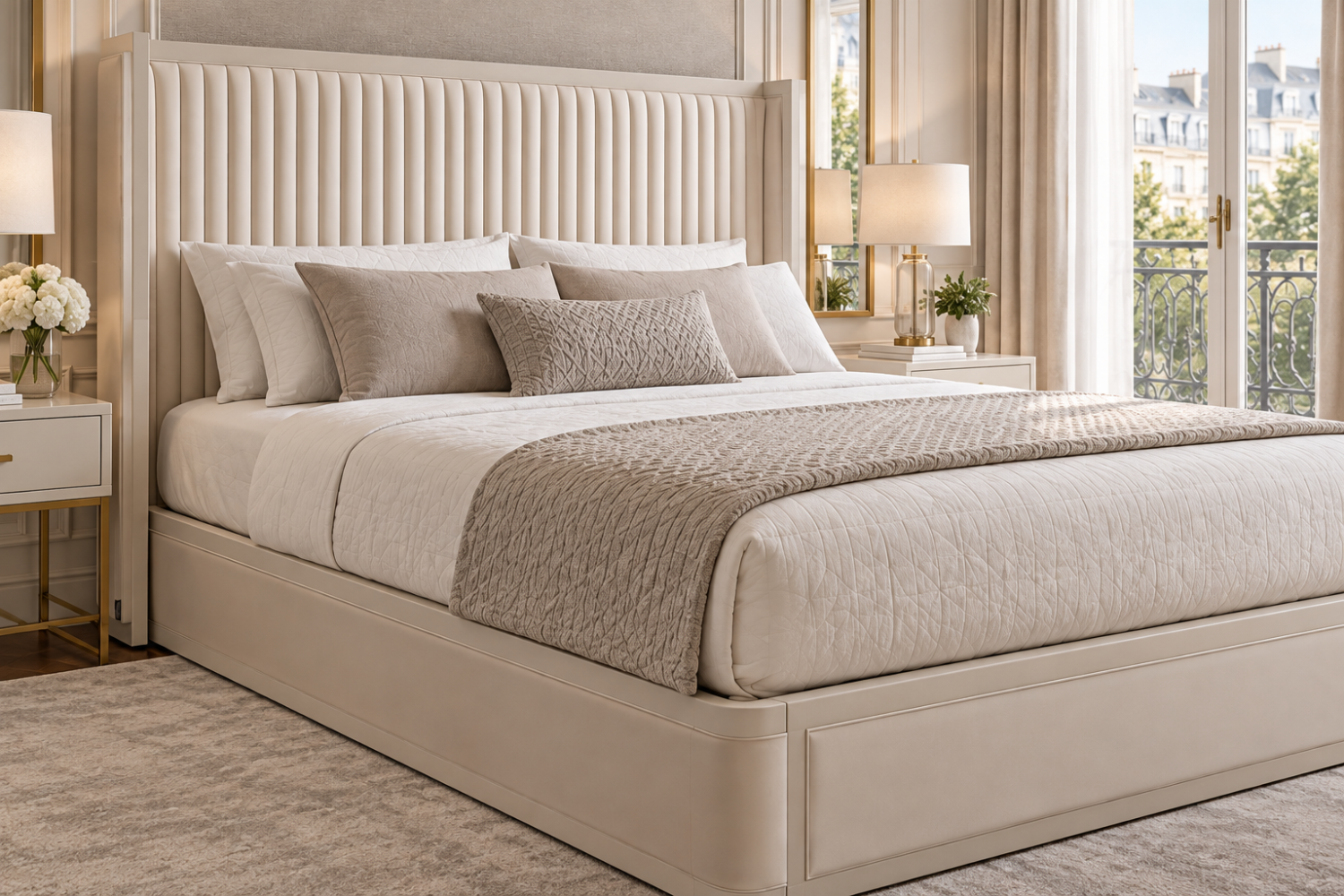
An armoire wardrobe does more than hide clothing. As a freestanding piece, it can establish the scale of a bedroom, add architectural presence without construction, and bring useful storage to a room that lacks a full built-in closet. The right choice depends on proportion, opening clearance, finish, and how the piece relates to the rest of the room.
Visit the EuroHome Design Center to discuss a freestanding storage piece for your bedroom.
An armoire wardrobe is a freestanding cabinet designed to store clothing, linens, accessories, or other bedroom essentials behind doors. Unlike a built-in, it arrives as furniture rather than construction. That distinction gives it visual weight and flexibility: it can act as a single statement piece, move with a changing room plan, or add enclosed storage where a wall cannot be altered.
The terms armoire and wardrobe are often used interchangeably in furniture searches. In practice, both describe tall enclosed storage, while armoire often suggests a more furniture-led piece with a decorative exterior. For a European interior, that difference matters. The cabinet is not simply a hidden utility zone. It is part of the composition, alongside the bed, nightstands, lighting, rugs, and artwork.
EuroHome's Sleeping collection is a useful starting point for coordinating bedroom storage. It brings together beds, nightstands, dressers, chests, and other pieces, making it easier to judge an armoire by the room around it rather than as an isolated purchase.
Size an armoire wardrobe from the room outward. Start with the wall, ceiling, baseboard, doors, windows, and walking paths, then decide how much clothing or linen storage the piece must carry. A well-proportioned armoire should feel substantial enough to anchor the room but not so deep or wide that doors, drawers, or circulation become difficult.
Record the available width, height, and depth at the intended location. Measure from the finished floor to the ceiling, not just to the top of a baseboard or crown molding. Then check the practical route into the bedroom: stair turns, elevator dimensions, door openings, and hallway corners can be more restrictive than the final wall.
Capacity is not the only sizing question. A very wide armoire may solve a storage shortage but overwhelm a compact room. In a larger primary bedroom, a single tall piece can create focus, while two narrower cabinets may give a more balanced rhythm. In a guest room, a moderate-width unit can provide enclosed storage without competing with the bed.
Use the bed as a reference point. Low beds and streamlined platform beds often benefit from a taller vertical counterpoint. A substantial upholstered bed may call for a calmer armoire profile, so the room has one clear focal point instead of several competing silhouettes.
Choose an armoire door style according to the room's width, the amount of access you need, and the mood you want the storage to create. Hinged doors offer a familiar full view of the interior, sliding doors reduce front clearance, and paneled or mirrored fronts change how the cabinet relates to light and architecture.
| Door style | Best fit | Design effect |
|---|---|---|
| Hinged | Bedrooms with generous clearance in front | Traditional furniture presence and broad access |
| Sliding | Tighter walkways or furniture placed opposite | Quiet, uninterrupted front plane |
| Paneled | Rooms that need texture without visual glare | Architectural rhythm and a tailored appearance |
| Mirrored | Rooms that need reflected light or a dressing function | More brightness, with a more active visual surface |
Hinged doors make it easy to see the full interior, but they require a clear opening zone. Sliding fronts are useful when the bed or a bench sits close to the cabinet, although access may be limited to one section at a time. Paneled fronts are often the most forgiving choice when the goal is a quiet, furniture-like statement.
Mirrors can help in a darker room, but use them intentionally. If the bedroom already has a large mirror, reflective nightstands, or glossy surfaces, a wood or lacquered front may provide better balance. Door detailing should also relate to the room's existing language. A simple contemporary bedroom usually benefits from restrained lines, while a more expressive European interior can support fluting, relief, contrasting panels, or sculptural hardware.
The finish determines whether an armoire wardrobe recedes into the bedroom or becomes its statement. Natural wood adds warmth and visible grain, matte lacquer creates a calm modern plane, gloss lacquer reflects light, and textured surfaces add depth at a distance. Choose one finish that relates to the room, then let the other furniture provide contrast rather than matching every piece exactly.
EuroHome's Bedroom Chests collection illustrates how storage can combine practical capacity with a sculptural silhouette. Its range includes vertical and contemporary forms, along with lacquered finishes, natural wood, and metal accents. Those are useful reference points when deciding whether an armoire should feel warm and tactile, crisp and architectural, or more decorative.
Wood is a strong choice when the bedroom already includes oak, walnut, ash, or another visible grain. The goal is not necessarily to match the bed exactly. Instead, repeat a related undertone or grain direction so the room feels connected. A darker wood armoire can ground pale bedding and walls, while a lighter finish can keep a tall cabinet from feeling heavy.
Matte lacquer suits a restrained contemporary interior because it minimizes visual noise. Gloss lacquer can brighten a room and emphasize the cabinet's geometry, but it also reflects windows and lighting more actively. Sample the finish near the actual bedroom light sources before deciding. Morning daylight, warm bedside lighting, and overhead fixtures can make the same finish look noticeably different.
Hardware should support the cabinet's proportions. Long pulls emphasize height, small knobs feel quieter, and integrated pulls create a cleaner front. Look closely at how the hardware aligns with door divisions and nearby nightstands. These small relationships often determine whether a freestanding piece looks custom to the room, even when it is not built into the wall.
Compare European bedroom storage finishes and silhouettes before finalizing the armoire's material and hardware.
An armoire wardrobe is often preferable to built-in storage when you want a strong piece of furniture, need flexibility, or do not want construction work. It can add enclosed storage to a guest room, preserve an older home's architecture, or solve a layout problem without committing an entire wall to cabinetry. Built-ins may offer maximum wall-to-wall capacity, but they are not always the best design decision.
Built-in storage can still be the right answer when every inch of capacity matters, the layout is permanent, or the room already has a strong architectural plan for cabinetry. The decision should be based on use and longevity, not on the assumption that more storage is always better.
Remember that a tall freestanding cabinet should be installed and secured according to the manufacturer's guidance. Heavy doors and stored items change the load over time. Confirm floor level, wall conditions, and anchoring requirements before the piece is put into service.
Place an armoire wardrobe where it supports the bedroom's daily sequence and visual balance. The most useful position is not always the largest empty wall. Consider what you see when entering, how doors open, where morning light falls, and whether the piece competes with the bed or blocks a window, radiator, outlet, or return-air grille.
For a smaller room, place the cabinet on the wall with the least disruptive door swing and choose a finish that relates to the wall color. For a larger room, use the armoire to define a dressing zone, guest zone, or visual endpoint. The piece should make the layout feel more intentional, not merely more full.
Coordinate by proportion, finish family, and purpose rather than by forcing every item to come from one matching set. EuroHome's Venisio Dresser, for example, is a geometric wood storage piece with a strong patterned facade. It can serve as a reference for how much visual movement a room already has before you choose a quieter or more expressive armoire front.
Use the Sleeping collection to compare the scale of the bed and smaller casegoods around the cabinet. A low dresser can balance the armoire's height, while a restrained nightstand can prevent the room from becoming too busy. If the design is being planned as a complete bedroom, bringing measurements, ceiling height, finish samples, and a simple furniture plan to the EuroHome Design Center can make the comparison more concrete.
Talk with EuroHome about proportion, finish, and placement for a European bedroom storage plan.
A freestanding armoire is a design decision as much as a storage decision. These answers cover the practical questions that usually determine whether one will work in a European-inspired bedroom.
Both are tall enclosed storage cabinets. In everyday furniture language, armoire often emphasizes a decorative, furniture-like cabinet, while wardrobe can describe a broader range of clothing storage, including fitted or modular systems. For this guide, armoire wardrobe means a freestanding piece selected for both storage and visual presence.
It can be, provided the depth, door clearance, and circulation are measured carefully. A tall, relatively narrow piece uses vertical space without spreading storage across the entire room. Sliding doors or a restrained finish may help when the bed or a walkway sits close to the cabinet.
It does not need to match exactly. A related wood tone, hardware finish, or proportion is usually enough to create continuity. In fact, matching every item can make the room feel like a set. Use the armoire to add contrast while repeating one or two details from the bed and nightstands.
It can replace some or all of the storage function when the cabinet's interior meets your needs and the room has enough clearance. It is especially useful when you want flexibility or want to protect existing architecture. Measure the interior capacity and access before assuming a freestanding piece will hold everything a built-in does.
Store the items that benefit from enclosed, accessible space: hanging clothing, folded garments, linens, accessories, or seasonal pieces. Keep the interior organized around the cabinet's actual shelves, rods, and drawers. Avoid overloading doors or shelves, and follow the manufacturer's weight and anchoring guidance.
The best armoire wardrobe is not simply the largest cabinet that fits. It has a proportion that respects the bedroom, doors that work with the circulation, a finish that supports the interior, and enough flexibility to remain useful as the room evolves. Freestanding storage earns its place when it solves a practical need while contributing the visual authority of a considered European furniture piece.
Explore EuroHome's European bedroom storage and related casegoods, then bring your measurements and room plan to the Design Center when you are ready to compare options.

