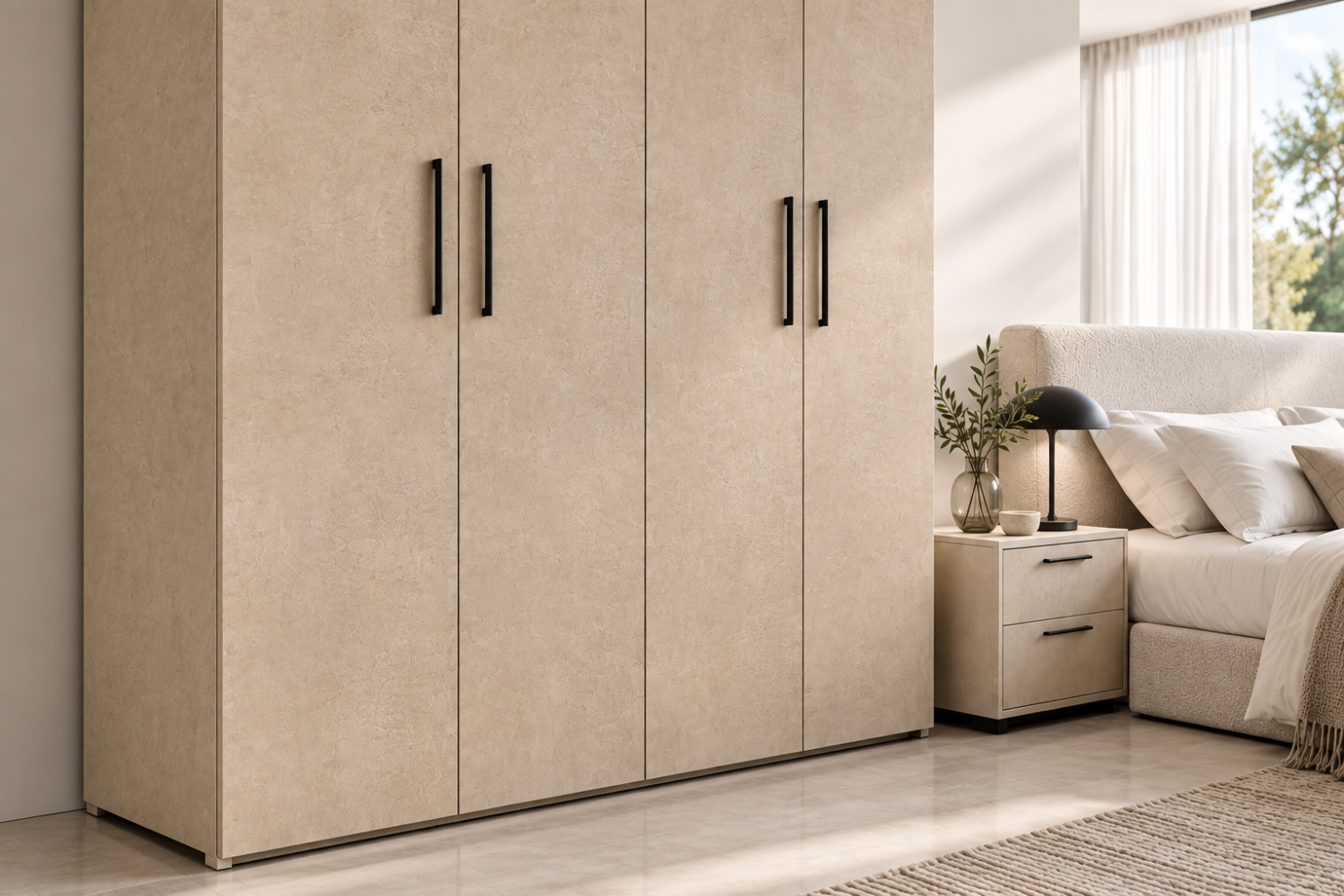
.
An armoire wardrobe can solve a storage problem while giving a bedroom a stronger sense of proportion. As a freestanding cabinet, it adds enclosed space without committing the room to construction. The best choice balances what you need to store with the way the piece relates to the bed, windows, doors, lighting, and surrounding finishes.
Quick answer: Choose an armoire wardrobe by auditing your clothing and linens, measuring the wall and delivery path, checking door clearance, and comparing the piece with your bedroom's scale. A freestanding armoire offers furniture-level flexibility and visual presence. A built-in or custom wardrobe may be better when you need wall-to-wall capacity or must work around unusual architecture.
This guide focuses on the buying decision itself. It explains what an armoire is, how to size it, which storage features matter. How to select a finish, and when a freestanding cabinet makes more sense than a built-in system.
An armoire wardrobe is a freestanding cabinet designed to store clothing, linens, accessories, or other bedroom essentials behind doors. The terms armoire and wardrobe are often used interchangeably in furniture searches. In practice, armoire usually suggests a furniture-led cabinet with a visible exterior, while wardrobe is a broader term for enclosed clothing storage.
That distinction matters when you are furnishing a design-conscious bedroom. An armoire is not only a container for garments. Its height, width, door pattern, hardware, and finish become part of the room's composition. It can introduce a substantial vertical element beside a bed, fill a wall that cannot be altered. Or provide enclosed storage in a guest room without turning the space into a construction project.
A well-chosen armoire wardrobe also keeps the bedroom visually quiet. Doors conceal clothing and accessories, while the exterior contributes the character that an open rack or improvised shelving may lack. This can be especially useful when the bedroom is meant to feel calm, coordinated, and complete.
Start by treating the piece as furniture and storage at the same time. If you assess only capacity, you may overlook its visual weight. If you assess only appearance, you may end up with shelves, rods, or drawers that do not match your daily routine.
Size an armoire wardrobe from the room outward. Measure the available wall, ceiling height, baseboards, nearby doors, windows, outlets, and walking paths before comparing styles. Then measure the clothing and household items the cabinet must hold. A piece should feel substantial enough to anchor the room without making doors, drawers, or circulation difficult.
Record width, height, and depth at the intended location. Measure from the finished floor to the ceiling and note crown molding or other trim that changes the usable height. Check the route into the room as well. Hallway corners, stair turns, elevator dimensions, and door openings can be more restrictive than the final wall.
Leave intentional breathing room beside the cabinet when the room allows it. A small gap can help an armoire read as a composed furniture piece instead of a wall that has been filled from edge to edge. At the same time, do not assume that an empty gap solves every clearance issue. The doors still need room to open, and the person using the cabinet needs enough space to stand comfortably in front of it.
Mark the door swing on the floor with painter's tape before purchasing. Walk through the space while imagining the doors open. Can you reach a hanging garment without blocking the bedroom entrance? Can a second person pass behind you? Will a nightstand, bench, radiator, or window treatment interfere?
Depth deserves the same attention. A deeper cabinet may offer more useful hanging capacity, but it also projects farther into the room. A shallower piece may suit a guest room or narrow bedroom, provided the interior layout still supports the items you want to store. The right depth is the one that gives you practical access without forcing the furniture to dominate circulation.
| Measurement to check | Why it matters | Buying question |
|---|---|---|
| Wall width | Determines how the cabinet relates to adjacent furniture and openings. | Will the armoire look balanced on this wall? |
| Ceiling and trim height | Controls the visual top line and installation clearance. | Does the height feel intentional rather than cramped? |
| Cabinet depth | Affects storage potential and floor circulation. | Can doors open without narrowing the route through the room? |
| Delivery route | Protects against a piece that fits the room but cannot reach it. | Can it pass through every door, turn, and stair? |
The most useful armoire wardrobe is organized around your actual inventory, not a generic list of features. Before shopping, separate long garments, short-hanging clothing, folded pieces, shoes, bags, linens, and seasonal items. Count the categories that matter to you and note which ones need enclosed space.
Hanging space is useful for garments that crease easily or need to remain visible. Check whether the interior can accommodate the length of your coats, dresses, jackets, or shirts. If you mostly fold knitwear, denim, and casual clothing, a cabinet with generous shelving may serve you better than a piece devoted to a single long rod.
Shelves support folded clothing, blankets, handbags, and shoes when their position matches the user's reach. Drawers can contain smaller accessories and reduce visual clutter. Consider where you want daily items to sit, where seasonal items can go, and whether the doors conceal the interior clearly enough for the room's intended use.
Adjustability can be valuable, but do not treat it as automatically superior. A flexible interior helps when your storage needs change. A more fixed arrangement may feel simpler when you already know the categories and proportions you need. Ask what can be adjusted, how easily it can be adjusted, and whether the change requires tools or professional assistance.
Storage planning should also leave a little room for change. A cabinet that is completely full on move-in day may become frustrating after a new season of clothing or a change in household needs. Build flexibility into the decision without buying a piece that is so large it overwhelms the bedroom.
Neither a freestanding armoire wardrobe nor a built-in system is universally better. The right option depends on the room, the length of time you expect to stay, the storage volume, and whether the architecture calls for a tailored solution.
| Consideration | Freestanding armoire wardrobe | Built-in or custom wardrobe |
|---|---|---|
| Flexibility | Can be repositioned if the room plan changes. | Is designed for one wall or architectural condition. |
| Visual role | Reads as a furniture piece with a distinct exterior. | Can recede into the architecture for a continuous wall. |
| Unusual walls | May need clearance around slopes, corners, or trim. | Can be planned around challenging dimensions. |
| Scope | Useful when you need a defined storage piece without construction. | Useful when you need broad capacity, integrated zones, or a tailored fit. |
Choose a freestanding cabinet when you want the bedroom to retain a furniture-led character. When you may change the room later, or when one well-proportioned piece solves the storage need. It can also be a strong choice for a guest room or a secondary bedroom. It suits a home where the owner wants the option to move or replace the cabinet.
Consider a built-in or custom wardrobe when the room has sloped ceilings, difficult corners, limited circulation, or a need for wall-to-wall storage. A custom approach may also make sense when storage must coordinate with a larger renovation. EuroHome's Sleeping collection includes custom wardrobes, walk-in closet systems, and bespoke built-ins for architectural constraints. Customization should be confirmed for the specific project rather than assumed for every item.
The decision is not simply freestanding versus built-in. It is furniture flexibility versus architectural integration. If the room benefits from a strong, finished object, an armoire may be the better design move. If the room's geometry is the problem, a tailored system may use the available space more effectively.
Choose the finish after considering the bedroom's larger material story. Look at the bed, flooring, nightstands, lighting, rugs, wall color, and artwork. The goal is not necessarily to match every surface. A coordinated room usually has a relationship among finishes, with enough variation to feel layered rather than flat.
A warm wood finish can support a bedroom with natural texture and softer contrast. A darker finish may create architectural weight and help a pale room feel grounded. A lighter finish can make a substantial cabinet feel less visually heavy. These are general design directions, not rules. The best choice depends on the surrounding materials and the amount of visual contrast the room can carry.
Look closely at door fronts and hardware. Clean slab doors may suit a quiet contemporary room. Framed doors, reeded details, or a subtle grain can add depth when the rest of the room is restrained. Hardware scale matters as well. A small cabinet can look overwhelmed by oversized pulls, while a tall piece may need hardware with enough presence to feel balanced.
View finish samples in morning, afternoon, and evening light if possible. A color that feels neutral in a showroom may read warmer or cooler in the bedroom. Artificial lighting changes the way wood tones, painted surfaces, and metal hardware appear. The goal is a finish that remains comfortable across the times of day when the room is used.
Material and finish questions can also be practical. Ask how the surface should be cleaned, how it handles everyday contact, and whether the manufacturer provides care guidance. Do not assume that two pieces with similar colors have the same maintenance needs. A design professional can help compare samples with the room's existing materials before you commit.
Use this sequence to turn an attractive option into a confident decision.
Safety belongs in this final check too. Tall storage should be stable and installed according to the manufacturer's instructions. The U.S. Consumer Product Safety Commission says its clothing-storage-unit standard includes stability testing with loaded drawers, multiple drawers open, carpeting, and simulated interaction by children. It also advises anchoring existing top-heavy furniture with anti-tip brackets and installing supplied anti-tip devices right away. Review the CPSC clothing-storage-unit safety guidance and follow the instructions for the exact piece you purchase.
An armoire wardrobe feels most successful when it is part of a room plan rather than an isolated storage purchase. Relate its scale to the bed. Repeat or intentionally contrast its finish with the nightstands. Give the doors enough clearance to function. Then consider the sightlines from the bedroom entrance and from the bed.
Coordination does not mean that every piece must come from one collection. It means the room has a clear logic. A substantial armoire may need a simpler bed and lighter accessories. A quiet cabinet may allow a sculptural headboard or more expressive lighting to lead. The balance depends on the room's proportions and the atmosphere you want.
EuroHome's design-led process connects space planning, product selection, and installation support. That does not mean every purchase includes a full design service. It does mean that a consultation can be useful when you are comparing a freestanding cabinet with a custom wardrobe. Working around a difficult room, or trying to create a cohesive European bedroom.
An armoire is generally a freestanding, furniture-led cabinet with enclosed storage. Wardrobe is a broader term that can describe a freestanding cabinet, a built-in unit, or another enclosed clothing-storage format. In product searches, the terms overlap, so compare the actual dimensions, interior layout, doors, and finish rather than relying on the label alone.
The best armoire wardrobe is the one that fits the room, stores your actual inventory, opens comfortably, and supports the bedroom's design language. Prioritize wall and delivery measurements, door clearance, useful hanging or shelving space, stable construction, and a finish that works with the bed and nearby furniture. A beautiful cabinet that blocks a doorway or lacks the right storage zones is not the best choice for that room.
Yes. Armoires remain useful when homeowners want enclosed storage with the visual presence of furniture. They can add clothing or linen storage without committing to a built-in installation, and they can work in primary bedrooms. Guest rooms, dressing areas, and other spaces where a freestanding piece is more appropriate than a full wall system.
Choose a built-in or custom wardrobe when you need wall-to-wall capacity, must work around unusual architecture, or want storage to disappear into the room's architecture. A freestanding armoire is often better when flexibility, furniture character, or a simpler project scope matters more. Compare both options after measuring the room and defining the storage problem.

