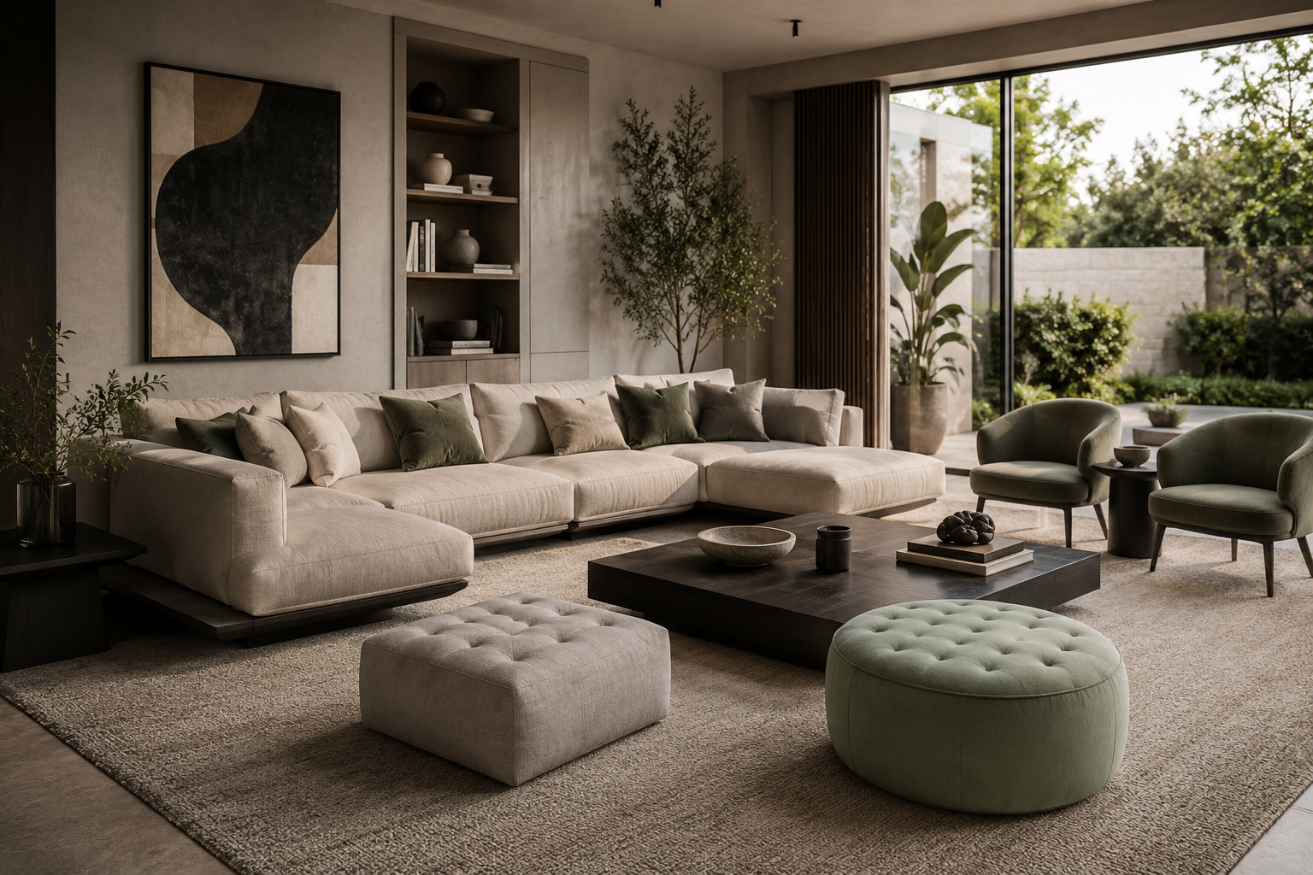
A luxury accent chair should do more than fill an empty corner. At its best, it changes how the entire room is read: the eye pauses, the seating plan gains purpose, and materials that once felt disconnected begin to make sense together. The most successful choice is not necessarily the loudest chair. It is the one whose silhouette, scale, upholstery, and craftsmanship create exactly the right degree of tension within the room.
Explore EuroHome Interiors lounge chairs and find a statement seat with the right presence.
That distinction matters when buying premium furniture. A chair can look exceptional in isolation yet feel visually heavy beside a low sofa, undersized beneath a tall window, or awkward when its arms interrupt a room's sightlines. It can also look restrained in a product image but become the room's defining object once its curved back, tailored seam, or open base is placed against the architecture.
This guide explains how designers assess a luxury accent chair before committing to it. It covers visual weight, scale, craftsmanship, upholstery, comfort, circulation, placement, and the practical questions that distinguish a considered purchase from an expensive guess. Use it to judge a chair as part of a complete interior, not merely as an attractive object.
A luxury accent chair succeeds when its design role is clear. It may anchor a conversation area, soften an angular room, preserve a view, or create a private reading seat. Define that job before comparing colors or finishes, because purpose determines the right silhouette, visual weight, comfort level, and placement.
Begin by asking what the room lacks. If a large sectional dominates the space, the chair may need an airy frame and visible floor beneath it. If a room feels sparse or architecturally plain, a more sculptural seat can introduce a focal point. In an entertaining space, the chair may need to turn toward different conversation groups. In a quiet bedroom, tactile upholstery and a supportive seat may matter more than dramatic presence.
An accent chair usually performs one of three visual jobs. As a focal point, it draws attention through a distinctive profile, contrasting material, or confident color. As a bridge, it repeats elements already in the room, such as a sofa's upholstery tone and a side table's metal finish, creating continuity without appearing matched. As a supporting piece, it completes a functional seating plan while allowing art, architecture, or a view to remain dominant.
The focal-point approach requires restraint elsewhere. A chair with a generous curved back, broad arms, and dense upholstery already carries substantial visual information. Placing it beside an equally assertive table, patterned rug, and dramatic lamp can make every object compete. A quieter neighboring piece gives the chair enough negative space to read clearly.
Stand at the room's main entrance and identify where the eye naturally travels. Note windows, fireplaces, art, long walls, and the largest furniture pieces. Then sit in the existing seats and check what remains visible. A chair should strengthen these sightlines rather than interrupt them without purpose.
Also consider how the room is experienced in motion. A statement seat may look balanced from the sofa but expose an unfinished back to the main hallway. In open-plan interiors, the rear and side profiles matter almost as much as the front. A fully resolved chair can act like sculpture from every approach, while a visually dense back may be better placed against a wall.
Silhouette establishes character, while visual weight determines how forcefully the chair occupies the room. Curved backs feel fluid and inviting; crisp angles feel architectural and precise. Open legs, slim arms, and visible floor reduce apparent mass. Upholstered bases, deep seats, and broad backs create a stronger anchor.
Two chairs with similar measurements can feel entirely different in the same room. A low, fully upholstered chair may appear grounded and substantial. A taller chair on slender legs can feel lighter because the eye sees floor and wall through and beneath it. This perceived mass is visual weight, and it often matters more than width alone.
Assess visual weight against the largest nearby piece. Beside a deep modern sofa or sectional, a delicate chair may appear incidental unless its color or profile gives it authority. Beside a slim sofa on raised legs, a block-like chair can feel disproportionately heavy. The objective is not perfect similarity. It is a deliberate relationship in which each piece remains legible.
Curves are effective when a room contains many straight architectural lines. A rounded back or continuous arm can soften the grid created by windows, millwork, rugs, and rectangular tables. Angular chairs, by contrast, can bring order to rooms filled with soft upholstery, flowing drapery, or irregular accessories.
Look beyond a simple curved-versus-square label. Study where the chair changes direction. A sharply pitched back communicates energy. A continuous shell feels enveloping. A low horizontal arm extends the room visually, while a high arm creates a more private seat. These details affect both mood and function.
Negative space is the visible air around and through furniture. It allows a room to feel composed rather than filled. A chair with an open base can preserve a long view across the floor. An exposed frame may reveal the edge of a rug or the form of a table behind it. A solid swivel base or generous skirt creates more visual closure.
Test sightlines from standing and seated positions. A high back can frame a corner beautifully but block art or a window when viewed from another room. A low chair can preserve an outdoor view, yet it may lack presence beneath tall ceilings. The right solution supports the architecture without disappearing into it.
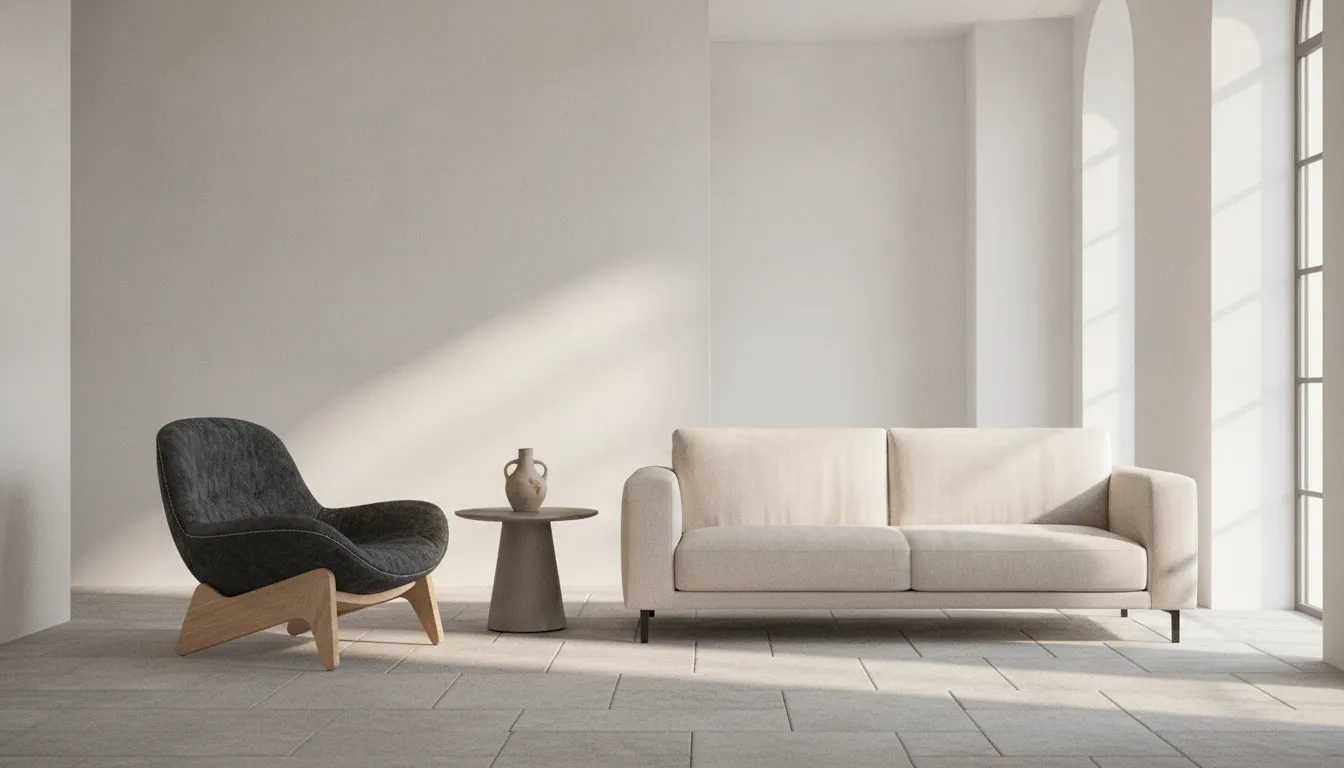
Correct scale is a relationship, not a single measurement. Compare the chair with the sofa, tables, rug, ceiling, and available floor area. Then confirm circulation, door access, and reclining or swivel movement. A well-scaled chair has room to breathe, supports conversation, and never makes a natural walking route feel improvised.
Record the chair's overall width, depth, height, seat height, arm height, and seat depth. Overall dimensions establish the footprint, but seat and arm measurements determine whether it works with nearby furniture. A chair's arms can feel awkwardly high beside a low sofa. A very deep seat may look elegant yet be uncomfortable for someone who prefers a more upright posture.
Pairing the chair with a contemporary side table requires similar care. The table should be reachable without forcing the sitter to twist, and its height should make placing a drink or book feel natural. The grouping should read as one functional composition, not as separate objects parked near each other.
Use painter's tape to mark the chair's full footprint, then walk through the room as you normally would. Approach the sofa, open nearby doors, reach the windows, and move between adjoining spaces. Do not test only the ideal path. Consider how guests move when another person is seated or when the room is actively used.
Include every operational dimension. A swivel chair needs space to rotate without striking a table. A reclining chair needs clearance in both front and back. A loose ottoman expands the practical footprint. If the chair faces a conversation area, account for the sitter's legs as well as the chair itself.
Measure the complete chair. Record overall width, depth, height, seat height, seat depth, and arm height rather than relying on one headline dimension.
Tape the footprint. Mark the outer dimensions on the floor and leave the tape in place long enough to experience normal movement around it.
Check the delivery route. Measure doors, halls, turns, stairs, and elevators between the entrance and the intended room.
Test the primary sightlines. View the taped area from entrances, adjacent rooms, existing seats, and the main standing positions.
Account for movement. Add the space required for swiveling, reclining, an ottoman, and the sitter's legs.
Compare neighboring heights. Confirm that the chair's seat and arms relate comfortably to the sofa and side table.
Review the whole composition. Make sure the chair, table, lamp, and rug have enough space to read as a purposeful group.
For complex rooms, 3D visualization can reveal problems that tape alone cannot show, including the relationship between the chair's back height and a window, or the way a dark finish changes perceived mass. EuroHome Interiors offers space planning and visualization support through its King of Prussia design center.
Premium craftsmanship is visible in how consistently a chair resolves structure, upholstery, and detail. Examine the frame, joints, seam alignment, edge transitions, cushion response, and finish quality. The goal is not decoration for its own sake, but disciplined execution that keeps the silhouette crisp and the seating experience convincing.
A well-designed frame should explain the chair's form. Exposed wood or metal elements need clean transitions, balanced proportions, and a finish that suits the chair's intended character. On fully upholstered chairs, press gently at the arms and back to assess whether the form feels stable and unified. A substantial appearance should be supported by substantial construction, not merely extra padding.
Study how the seat meets the frame and how the back connects to the arms. These junctions reveal the level of thought behind the design. Awkward gaps, inconsistent edges, or decorative details that do not align can dilute an otherwise compelling silhouette. Precision matters because accent chairs are often viewed at close range and from multiple angles.
Upholstery is architecture in soft material. Seams define edges, control curves, and direct the eye. On a tailored chair, stitching should reinforce the intended geometry. A centered seam can emphasize symmetry; a continuous seam can trace a shell-like profile; a deliberate welt can sharpen an edge. The pattern, pile, and grain should appear considered across visible surfaces.
Examine high-tension areas such as the front rail, arm corners, and transition from seat to back. Fabric should feel appropriately controlled rather than loosely gathered unless softness is intentional. Leather should suit the radius of the form; complex curves require careful handling to avoid distracting tension. Ask to see upholstery and finish samples together, because texture and undertone can shift under different light.
Comfort is not separate from quality. It is the result of proportion, support, and material behavior working together. Sit long enough to notice where the chair supports you, not merely whether it feels soft during the first minute. A soft seat can be inviting but may require more effort to rise from. A firmer seat can preserve a tailored profile and support conversation-oriented sitting.
Consider the intended user and duration. A dramatic occasional chair can prioritize sculptural presence, but a chair used nightly should offer appropriate back support, a comfortable seat depth, and arms that assist movement. Premium buying decisions improve when comfort expectations are specific rather than reduced to a vague request for softness.
The best upholstery balances tactile appeal, visual effect, maintenance expectations, and the chair's intended use. Leather can emphasize clean form and develop character; fabric can add softness, color, or pattern. Finish samples should be judged in the room's actual light and beside existing materials before a final decision.
Texture changes visual weight. A smooth, dark leather can make a compact chair feel more defined and substantial. A pale, softly woven fabric can diffuse the outline and create a quieter presence. A pronounced weave catches light and adds depth, while a fine, even surface emphasizes the precision of the silhouette.
Think about distance as well. From across the room, color and outline dominate. Up close, the quality of the weave, hand of the leather, seam work, and finish become apparent. A successful material performs at both scales. It supports the room's composition from afar and rewards attention when someone sits down.
A chair does not need to match the sofa, and often should not. The more sophisticated approach is to coordinate undertones and material temperature. A warm neutral chair can relate to walnut, brass-toned metal, or warm stone without duplicating any of them. A cooler upholstery can connect with gray-veined surfaces, dark metal, or blue-based art.
Review samples during the day and in evening lighting. Colors that feel balanced in sunlight can shift under artificial light. Place each sample vertically as well as horizontally, because light hits a chair's back differently from its seat. If the chair will sit near a window, check how strong light affects the material's appearance and choose care expectations accordingly.
Usage should direct the material choice. A chair in the center of a busy living area faces more contact than one in a bedroom corner. A seat used for entertaining may need a forgiving surface and a form that allows easy movement. A reading chair can prioritize tactile warmth and extended comfort.
| Decision factor | What to inspect | Why it matters |
|---|---|---|
| Visual weight | Color depth, texture, sheen, and base openness | Materials can make the same silhouette feel lighter or more substantial. |
| Daily use | Care instructions, surface resilience, and intended placement | The finish should suit how often and by whom the chair will be used. |
| Tailoring | Seams, pattern alignment, corners, and edge control | Precise upholstery preserves the chair's designed form. |
| Room harmony | Undertones beside sofa, rug, wood, metal, and stone | Coordinated undertones create cohesion without looking matched. |
| Light response | Appearance in daylight and evening illumination | Texture, color, and sheen can change throughout the day. |
Placement should improve both the room's composition and its use. Angle a chair to complete conversation, preserve an important view, or activate an underused corner. Pair it with only the supporting pieces it needs. The strongest arrangement feels intentional from the doorway and comfortable once someone sits down.
In a living room, an accent chair can close the open side of a seating group or create a bridge between zones. Angle it slightly toward the sofa when conversation is the priority. A rigid right angle can look formal and create a less natural exchange, while a subtle turn signals that the chair belongs to the group.
Use the rug to clarify the relationship. A chair floating far outside the rug may feel detached, while one pushed too deeply into the group can restrict movement. The seat should feel connected without narrowing the room's circulation. Browse the broader European living collection to compare how lounge chairs, tables, sofas, and storage pieces can work together.
A reading chair requires more than an attractive corner. Check natural and task lighting, a reachable surface, and the view from the seat. The chair should invite use without becoming a place where unrelated objects collect. One small table and a well-positioned light may be enough.
In a bedroom, maintain calm by choosing a chair whose scale respects the bed. A high, broad-backed chair can compete with the headboard, while a lower chair may extend the room's horizontal line. If the chair is visible from the doorway, consider its back and side profile as carefully as its front.
A visually distinctive chair benefits from negative space. Avoid surrounding it with several small accessories simply to make the area feel finished. Empty space can be the element that reveals the sweep of an arm, the precision of a base, or the relationship between upholstery and frame.
If a chair is meant to be admired from several directions, rotate it away from the wall and assess the composition from adjoining rooms. The goal is not to place a chair in the center for drama. It is to position it where its strongest profile supports the architecture and where its use still feels natural.
A confident purchase combines design judgment with verification. Confirm dimensions, materials, finish samples, comfort, room fit, delivery access, and how the chair relates to future changes. Premium furniture earns its place when it remains useful, visually coherent, and satisfying after the initial impact has passed.
A statement chair does not need to be trendy to be memorable. Enduring distinction usually comes from proportion, material quality, and an unmistakable silhouette rather than novelty alone. Ask whether the chair would still feel compelling if its color were neutral. If the answer is yes, the form is doing meaningful work.
Also consider how the room may evolve. A chair with a strong but versatile shape can move from a living room to a bedroom, library, or office as needs change. A piece that depends on one precise color scheme may be less adaptable. Flexibility is not a reason to choose something generic; it is a reason to seek a design with intrinsic integrity.
Request current dimensions and available material information, then compare them with your taped floor plan. Review samples next to the actual sofa, rug, wall color, flooring, and table finishes. If customization is available, change only what strengthens the room. More options do not automatically produce a better result.
EuroHome Interiors works with curated Italian and European furniture and provides design support that can help clarify scale, finishes, and room planning. That expertise is especially useful when a chair must coordinate with a larger furnishing plan or when its sightlines affect several connected spaces.
If any answer remains uncertain, pause before committing. A premium chair should resolve several design challenges at once, not create new compromises. Thoughtful comparison is part of the buying process and often reveals why one option feels composed while another merely looks impressive online.
Compare refined lounge-chair silhouettes for your next living space.
The price of a luxury accent chair varies widely according to design, materials, upholstery, construction, finish, and customization. Rather than using price alone as a quality signal, compare the frame, tailoring, comfort, material specifications, and how well the chair solves your room's scale and placement needs.
Customization depends on the specific chair and manufacturer. Some premium seating offers choices in upholstery, wood or metal finish, and other details, while other designs have fixed specifications. Confirm available options before ordering and review physical samples in the room's actual light whenever possible.
Follow the care guidance provided for the chair's exact upholstery and finish. Vacuum fabric gently when appropriate, address spills promptly using the recommended method, and avoid applying general cleaners without confirming compatibility. Keep documentation for the chosen material so future care decisions are based on its specific requirements.
Mark the chair's full footprint with painter's tape, include space for the sitter and any swivel or reclining movement, and walk every normal route around it. Check views from doorways and existing seats, compare its height with nearby furniture, and verify the delivery route before ordering.
The right luxury accent chair is not simply an accessory. It is a precise design decision that can redirect a sightline, balance a sofa, add tactile depth, and make a room more useful. The best choices combine a memorable silhouette with disciplined scale, credible craftsmanship, appropriate upholstery, and comfort suited to the chair's real role.
Approach the purchase as a designer would: begin with the room, define the chair's purpose, verify every measurement, and judge materials in context. When each decision supports the next, the chair feels inevitable in its setting. That is the difference between filling space and completing it.

