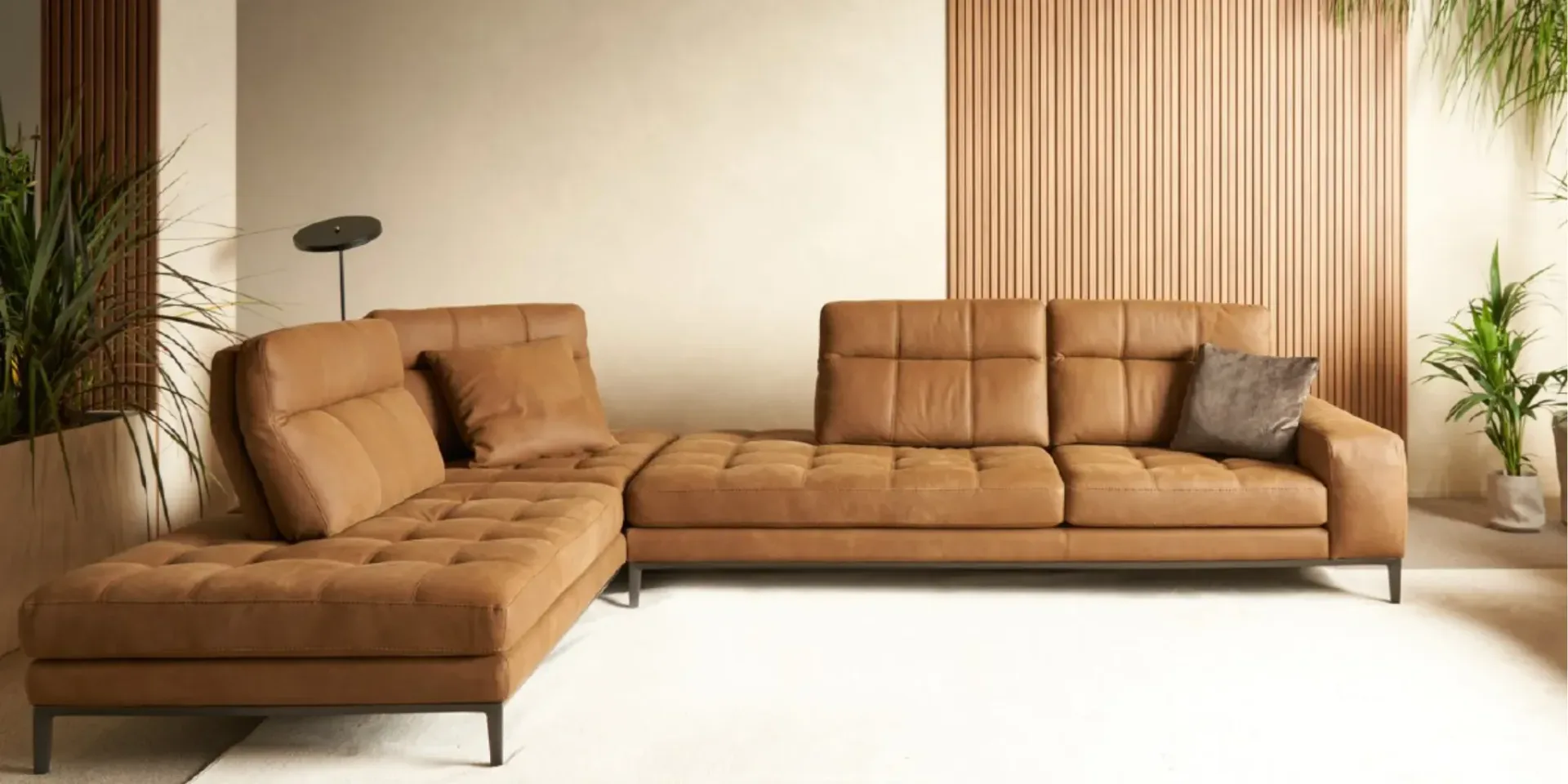
Large luxury sectional sofas only work when the longest side, the return, and the back height all fit the room you actually live in. Start with the wall, the depth in front of the seat, and the route from the door. A size that looks right in a showroom can still block a doorway or tower over a low window. The Design Center can review that footprint with you. Published size options, not a style name, tell you whether the piece belongs.
Call (610) 477-7760 or book a design consultation to check a sectional footprint against your room.
For this guide, large means a sectional whose longest side is about 110 inches or more, especially an L-shape that also runs deep into the room. That is a planning threshold, not a brand claim. Two pieces with the same style name can differ by a foot or more once you open the size list.
EuroHome publishes those differences on the product pages in the sofa and sectional collection. On November 6, 2026, these made-to-order sizes were listed:
Those four lines show why "large" is not one footprint. Bucatini's smallest listed size is already bigger than Angelica's largest. Barbine Chaise grows in one direction only. Read the size you would order, then compare that rectangle with the room.
A name does not tell you the shape. "Sectional" on these pages covers a square L, a chaise with one long side, and configurations that change which arm returns. Write down width and depth as two numbers. If you only write the longer one, you will approve a piece that fits the wall and still crosses the room.
Measure the wall at the floor and again about 18 inches up. Baseboards, a hearth, a low sill, or a floor register can shorten the usable run. Then measure from that wall to the nearest fixed thing opposite it: another wall, a doorway, or the dining table that stays put.
A practical test has three numbers:
An L-shape needs floor in two directions. Angelica Maxi is 120 inches by 120 inches, so the return claims as much depth as the main run claims wall. Bucatini Maxi is 135 inches by 135 inches. If the room is only a little deeper than the return, the sectional will pass a wall check and still fail the room.
Tape the full footprint, including the return or chaise, and live with it for a day. Walk to the kitchen, open the nearest door, and sit where the other chairs would be. A footprint that annoys you on a weekday will annoy you after delivery.
Photograph the tape from the doorway and from the seat you use most. Those two views catch different failures. From the door, you see whether the return blocks the path. From the seat, you see whether the opposite wall is still a comfortable distance away. If you share the decision with someone else, the photos keep you comparing the same plan.
Clearance is the space you still need after the sectional is in place. Judge each one separately. A piece can clear the wall and still fail the path around it.
Main walkway. Leave 30 to 36 inches where people carry things through the room. If the sectional's return crosses that path, step down a size or turn the layout rather than squeezing the aisle.
Seat to table. Sixteen to 18 inches is the working gap. Measure it from the front of the cushion, not from the back of the sofa.
Door swing. Open every door that meets the seating area and mark the arc on the floor. A door that now clears a chair may hit a deeper return.
Side reach. You still need a place to set a drink and a lamp. If the only spot for a side table is inside the walkway, the sectional is too deep for that wall.
The Access Board guide to accessible routes is the reference for the 36-inch route width. It is a building standard, not a furniture rule, but it is a clear way to test whether the path around a large sectional stays usable.
Back height changes the room as much as width does. A tall back can feel sheltering in a high-ceilinged room and like a partition everywhere else.
Angelica lists 29 and 40 inches. Barbine lists 33 and 42. With an 8-foot ceiling, or with a view from the living room into a dining area, a back under about 36 inches usually keeps the sightline open. A 40- or 42-inch back belongs where you want a more enclosed seat, not in front of a pass-through or a low window.
Check the back from the entrance and from a seat in the next room. If the top of the back cuts the window or hides the people across from you, the lower back is the better fit even when the larger footprint would fit the floor.
Seat depth is a separate comfort choice. The same pages list 20 inches on Angelica, 21 on Bavette, 22 on Barbine, and 23 on Bucatini. Sit in a comparable depth before you treat a deeper seat as automatically better. This guide does not cover cushion fill or upholstery. The sectional sofa material guide owns leather, fabric, and velvet.
Put every candidate on the same sheet: overall width, overall depth, back height, and seat depth. Then mark whether the size is fixed or offered in steps. Comparing names, or comparing only the longest side, hides the return.
Example: Angelica Sectional.
Listed sizes: 108, 116, or 120 in square.
What changes: Both sides grow together.
Example: Barbine Sectional.
Listed sizes: 113, 121, or 129 in square.
What changes: Both sides, taller back.
Example: Bucatini Sectional.
Listed sizes: 127, 131, or 135 in square.
What changes: Largest L in this set.
Example: Barbine Chaise.
Listed sizes: 68 in wide, 95 to 119 deep.
What changes: Depth only. The wall stays short.
The sizes above are the ones published on the product pages on November 6, 2026. Recheck the page for the configuration you want. A later size edit should change your tape, not the other way around.
Square L, three steps. Angelica, Barbine, and Bucatini each list Standard, Medium, and Maxi, and width and depth grow together. Moving up one step adds about 8 inches per side on Angelica and Barbine, and about 4 inches per side on Bucatini. That is a real change in floor area, not a trim choice.
Chaise that grows in one direction. Barbine Chaise Sectional keeps a 68-inch width and lengthens from 95 to 119 inches. Use it when the wall is limited and the depth is what you can spend. A chaise is still one lounging place, not a second sofa.
Same family, different job. Bavette's sectional is 111, 119, or 123 inches square. Dania, also on the collection page, lists configurations such as 104 by 104 and a 117.3 by 63.3 option. One is a deep L. The other can be a shallower run. Read the configuration, not only the collection name.
If two sizes both fit the wall, choose the one that keeps the walkway and the view. The larger size is not the more luxurious size. It is only the right size when the extra inches have a job.
A sectional can fit the room and still be unable to arrive there. Measure the path before you approve a size: the building entrance, every doorway, the tightest hall turn, and any stair landing. Measure the opening, not the door slab, and note handrails and a low ceiling on the turn.
Large sectionals usually arrive in sections, but a corner, an arm, or a chaise can still be a single heavy piece. Ask which pieces ship separate and what the largest piece measures, including its diagonal. A piece can pass a doorway at an angle when it will not pass square.
Write the narrowest opening next to the largest piece. If they are close, flag it before the order rather than hoping the delivery crew can solve it. EuroHome's shipping and delivery page is the place to confirm how receiving works for your address. The taped footprint in the room does not answer this question.
This page is only the scale and access decision. Other EuroHome pages already answer the neighboring questions, so use them instead of repeating them here.
If the question is budget, seating count, or which Italian sectional to buy, those are different decisions. Do not try to settle them from a tape measure.
Reduce the choice to four checks. The wall can hold the longest side. The room can hold the return without closing the 30- to 36-inch path. The back height keeps or blocks the view on purpose. The largest piece can pass the narrowest opening.
Use the published steps as the menu. On the November 2026 pages, that menu runs from Angelica at 108 inches square up to Bucatini at 135 inches square, with Barbine Chaise as the one-direction alternative. Pick the step that passes all four checks. If none does, the room needs a smaller configuration, not a larger sectional with a nicer fabric.
Bring the measurements, the taped photos, and the doorway notes to a consultation if you want a second set of eyes on the plan. The goal is a sectional that feels comfortable because it fits, not because it is the biggest size on the list.
Call (610) 477-7760 or schedule a design consultation and bring your wall, depth, and doorway measurements.
Use about 110 inches on the longest side as the point where a sectional becomes large for planning. EuroHome's current L-shapes go well past that: Bucatini is listed from 127 to 135 inches square, and Barbine's Maxi is 129 inches square.
Leave 30 to 36 inches on the main walkway and about 16 to 18 inches between the seat and a coffee table. Also check the door swing and a spot for a side table that does not sit in the path.
No. Standard, Medium, and Maxi are footprint steps on the same design. Angelica Standard is 108 inches square and Maxi is 120. Choose the step that fits the room. A larger size is not a higher grade of construction.
Measure the wall, the room depth, the back-height sightline, and every doorway and turn on the delivery path. Confirm the exact size option and how the piece ships before you approve it.
A large sectional feels right when its width, depth, and back height match the room and the route in. Measure those first, then choose the published size that passes.


