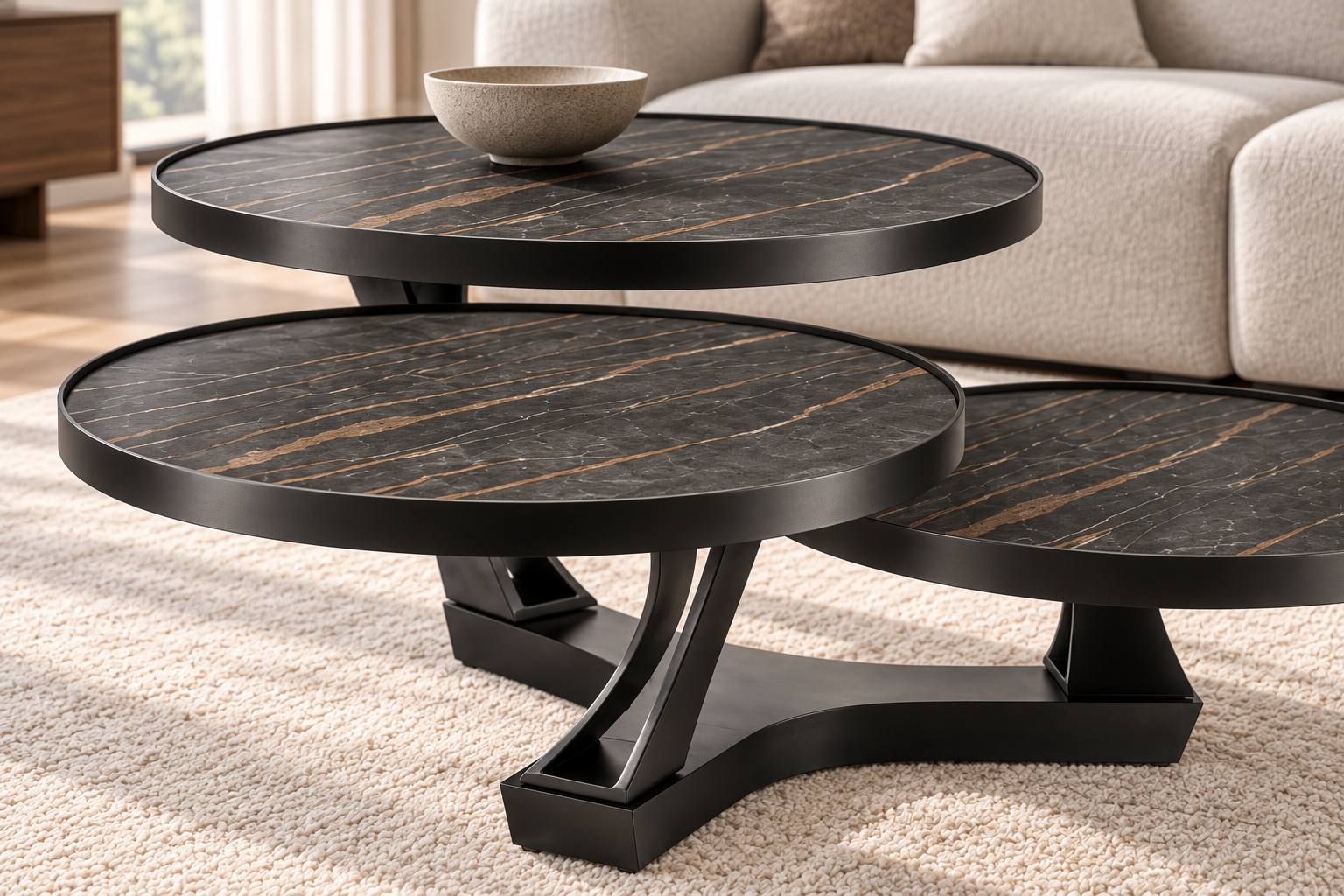
An Italian coffee table should do more than catch the eye. It needs to fit the seating, support everyday routines, and feel at home with the rest of the room. Before choosing a finish or silhouette, measure the space and think about how you use it. This guide to the italian coffee table covers material tradeoffs, useful proportions, and placement decisions that help a beautiful piece work well day after day.
Talk with EuroHome about your living room
The phrase can refer to a table made in Italy, a design associated with Italian makers, or a contemporary European look. Those are not interchangeable. If the place of manufacture matters to you, ask for the maker and country-of-origin details rather than relying on a style label alone. A table’s design language can be Italian-inspired even when the product comes from elsewhere.
Start with the experience you want. Is the table a landing place for drinks and books? Does it need to support a tray when friends visit? Will children use the living room for play? Your answers affect what material, edge, height, and footprint make sense. A visually striking piece is more satisfying when its surface and shape suit your actual routine.
Consider the room as a whole, too. A sleek table can feel comfortable in a traditional interior when you balance it with a soft rug, familiar upholstery, warm wood, or objects that carry personal meaning. European modern design does not require a cold or empty room. The goal is a considered mix, not a showroom-like match of every finish.
Material affects appearance, weight, care, and how confidently you can use the table. A coffee table may combine materials, such as a stone top with a metal base or wood paired with glass. Look at the whole construction: the surface, edges, supports, joints, and the way the base meets the floor. The available choices extend beyond stone; a resource discussing coffee-table material options also mentions glass, reclaimed wood, and resin. Read the coffee-table material overview.
Use the comparison below as a starting point, not a claim that every material behaves the same way. Finish, thickness, construction, and the maker’s care guidance matter. Ask for the specific product details before ordering.
| Material | What it can bring | Points to check | May suit |
|---|---|---|---|
| Wood | Warmth, visible grain, and a softer visual counterpoint to upholstery | Finish-care instructions, veneer or solid construction where specified, and susceptibility to marks | A layered room and regular everyday use |
| Stone | A substantial presence and natural variation from piece to piece | Weight, surface treatment, sealing or cleaning guidance, and whether samples represent natural variation | A room where a grounded focal point feels right |
| Glass | A lighter visual footprint and a view through to the rug | Cleaning needs, edge treatment, and whether the top feels appropriate for the household | A smaller or visually busy room that benefits from openness |
| Metal | A crisp outline or a slim support structure | Finish, touch points, stability, and how the tone relates to other hardware | A room needing a defined accent or visually fine base |
| Mixed materials | Contrast and a more individual balance of texture | How the components join, how each surface is maintained, and the overall visual weight | A personalized interior with more than one finish family |
For wood, compare the grain and tone with nearby furniture rather than trying to match every piece exactly. A close match can look deliberate, but a subtle contrast often feels more personal. With stone, remember that natural variation may make the delivered surface differ from a small sample. Ask what variation to expect and which cleaning products are suitable.
Glass and reflective finishes can keep a compact room from feeling visually crowded, but they show fingerprints and dust more readily. Metal details may connect to lighting or cabinet hardware, though repeating the same finish everywhere can make a room feel too coordinated. Mixed-material tables can bridge old and new furniture; check that each material has a role in the room, rather than introducing contrast for its own sake.
Measure the seating before you browse. Note the clear width between sofa arms, the depth from the front edge of the sofa to the opposite furniture or walkway, and the height of the seat cushion. Then measure any nearby lounge chair or sectional return. These dimensions describe the space a table must serve, not just the open patch of floor visible in a photograph.
As a useful planning starting point, look for a table around two-thirds the length of the sofa, then adjust to the seating arrangement and the available walking space. The table should not dominate the longest seat, but it should be large enough for people to reach. Treat this as a visual guide rather than a fixed rule: a pair of small tables or a sculptural compact table may work better with an unusual layout.
Height matters just as much as length. Compare the proposed top height with the sofa cushion. A table close to seat height, or a little lower, is often comfortable to reach from a seated position. If the top sits far below the seat, reaching for a glass can feel awkward. A higher surface may work better for serving, but check that it does not block sightlines across the seating group.
If you have a sectional, measure the inside corner as well as the main run. A broad rectangle can make a narrow passage feel pinched, while a round or oval top may ease movement around a tight corner. For a compact room, a small table can leave more open floor; for a long conversation area, a too-small table may feel disconnected from the sofa. Test the footprint in the room before settling on the shape.
There is no single clearance that suits every room. The right distance depends on the table’s depth, the sofa’s seat depth, the size of people using the room, and whether the gap is also a walkway. Leave enough room to sit comfortably, reach the top, and move around without turning sideways. If the path feels tight when you try the floor template, it will not improve once the table is in place.
Measure the route people use most often, not only the gap between the sofa and table. Include the path from an entry to a doorway, from the sofa to a reading chair, and around the end of a sectional. Avoid placing a table where an open drawer, recliner, or frequently used door needs to move. In a family room, consider where children play and where drinks or devices are most often set down.
When the room is small, do not automatically choose the tiniest table. First decide whether you can shift the sofa, use a pair of nested tables, or choose a shape that makes the route easier to navigate. In a larger room, one table may not serve every seat; a side table near a chair can make the arrangement more useful than stretching the central piece too far.
Shape is a practical decision, not just a style choice. A rectangular table often follows the line of a standard sofa and offers an extended surface. An oval can soften a long seating arrangement and has no sharp corners at its ends. A round table can work near a compact conversation group, while a square option may relate well to a broad, symmetrical arrangement.
Look at the outline of the furniture around the table. If the sofa has straight arms and a long profile, an oval or rectangular table can complement it without forcing a match. If the room already has many angular elements, a round top may introduce a useful curve. If chairs sit on more than one side, check that the shape can be reached from each seat and does not interrupt the main route.
For a sectional, place a paper outline within the inner corner and confirm that people can reach the table from both sides. A round table may help with circulation, but it can provide less usable surface than a rectangle with a similar maximum width. Compare the actual dimensions and the shape of the base; a broad base can take up floor space even when the top seems modest.
EuroHome’s coffee table selection can help you compare available designs. Consider it alongside the living room furniture collection so the table is evaluated with the seats and supporting pieces, not in isolation.
A modern table can bring clarity to a room with traditional architecture, patterned rugs, or well-loved furniture. Rather than trying to modernize everything at once, use the table as one considered contrast. A restrained silhouette can sit comfortably among detailed upholstery. A warm wood finish can connect with existing floors or a cabinet. A stone or glass surface can add a different texture without requiring a complete room makeover.
Let one or two features create the connection. Repeat a tone from the table in a lamp, frame, or small accessory, then allow other materials to remain distinct. Coordinate scale as well: a delicate base can disappear next to a large sofa, while a very substantial top may overwhelm a light arrangement. A tactile rug and comfortable seating can soften crisp lines and keep the room inviting.
Personal details are important. Books, objects collected during travel, and pieces passed through a family can make a contemporary table feel part of a lived-in home. Keep the surface useful by leaving space for daily items. The aim is not a perfectly styled vignette; it is a room where design and ordinary routines work together.
To balance the table with other pieces, explore living room side tables for a seat-side surface, or consider living room rugs as part of the seating zone. A rug can visually gather the furniture, but check that the table remains stable on its pile and that edges do not catch underfoot.
Look beyond the product photograph. Ask how the top is supported, whether the base feels stable, and whether the table wobbles when light pressure is applied to an edge. Inspect the underside and joints where possible. If the piece uses more than one material, ask how the components are secured and whether care instructions differ by surface.
Consider the edge profile and corners in relation to the household. A crisp edge may suit a formal room, while a softened profile may feel more comfortable in a busy family space. For stone and glass, ask about the weight and handling requirements. For wood and metal, confirm how the finish should be cleaned and what substances or tools to avoid. Follow product-specific guidance rather than assuming a general cleaner is safe.
Check that the listed dimensions include the full footprint, including any projecting feet or base. If the product is made to order or can be customized, confirm which measurements, finishes, and options are actually available for that model. EuroHome’s direct relationships with Italian and Danish manufacturers support custom sizing and finishes in its sourcing model, but availability is product-specific; confirm the options for the table you are considering.
When two designs both look right, compare them against the same practical criteria. A short written scorecard can prevent a striking finish from distracting from a poor fit. Give the most weight to what matters in your room, such as comfortable reach, easy movement, or a surface that suits regular use.
| Question | Option A | Option B | Why it matters |
|---|---|---|---|
| Does it fit the taped floor outline? | Yes / No | Yes / No | Confirms the footprint and traffic paths |
| Is the height comfortable from the main seat? | Measure and test | Measure and test | Supports easy reach while seated |
| Does the material suit daily care? | Review finish guidance | Review finish guidance | Sets realistic expectations for maintenance |
| Does the base feel stable and leave enough foot room? | Inspect / ask | Inspect / ask | Checks function beyond the top surface |
| Does it work with existing furniture? | Compare tones and scale | Compare tones and scale | Helps the table feel integrated, not isolated |
Ask for written product specifications and care information for both options. If dimensions or material descriptions are unclear, request clarification before comparing. A showroom visit can make it easier to judge finish, scale, and construction in person; EuroHome’s Design Center is in King of Prussia. You can also consider how the table relates to a lounge chair or the rest of your seating plan.
Use a final checklist to turn inspiration into a confident decision. Confirm dimensions, material, finish, and the exact configuration. If the table is customized, make sure the written order reflects the agreed size and finish. For a natural material, ask what variation is expected and whether the finish shown is representative.
EuroHome offers delivery options that include professional assembly and white-glove installation among its service model. Check the delivery information and confirm which service applies to your order. If you are coordinating a full room, a conversation with the design team can help relate the table choice to the wider plan.
Schedule a design consultation
No. The phrase may describe an aesthetic, a designer, a brand, or the place of manufacture. If origin matters, check the maker and country-of-origin information for the specific product.
Compare the table specification with the height of your sofa seat. A top near the cushion height or slightly lower is a useful place to start, but your preferred reach and the seat’s shape should guide the final choice.
No. Stone can create a substantial focal point, but it may also be heavy and needs care suited to its particular finish. Wood, glass, metal, or a combination may fit your room, habits, and maintenance preferences better.
Yes. Balance its lines with warm materials, comfortable upholstery, existing furniture, and personal objects. A modern piece can add contrast without requiring the rest of the room to change.
Choose the table after you know the sofa’s actual dimensions and seat height. If you are planning both together, compare them as one arrangement and test their combined footprints in the room before ordering.
The right Italian coffee table is the one that fits the room’s proportions, makes daily routines easier, and feels connected to the way you live. Measure before browsing, compare materials with care needs in mind, and test the footprint around your seating. With those decisions settled, you can choose a design that brings European character to your home without sacrificing comfort or practicality.


