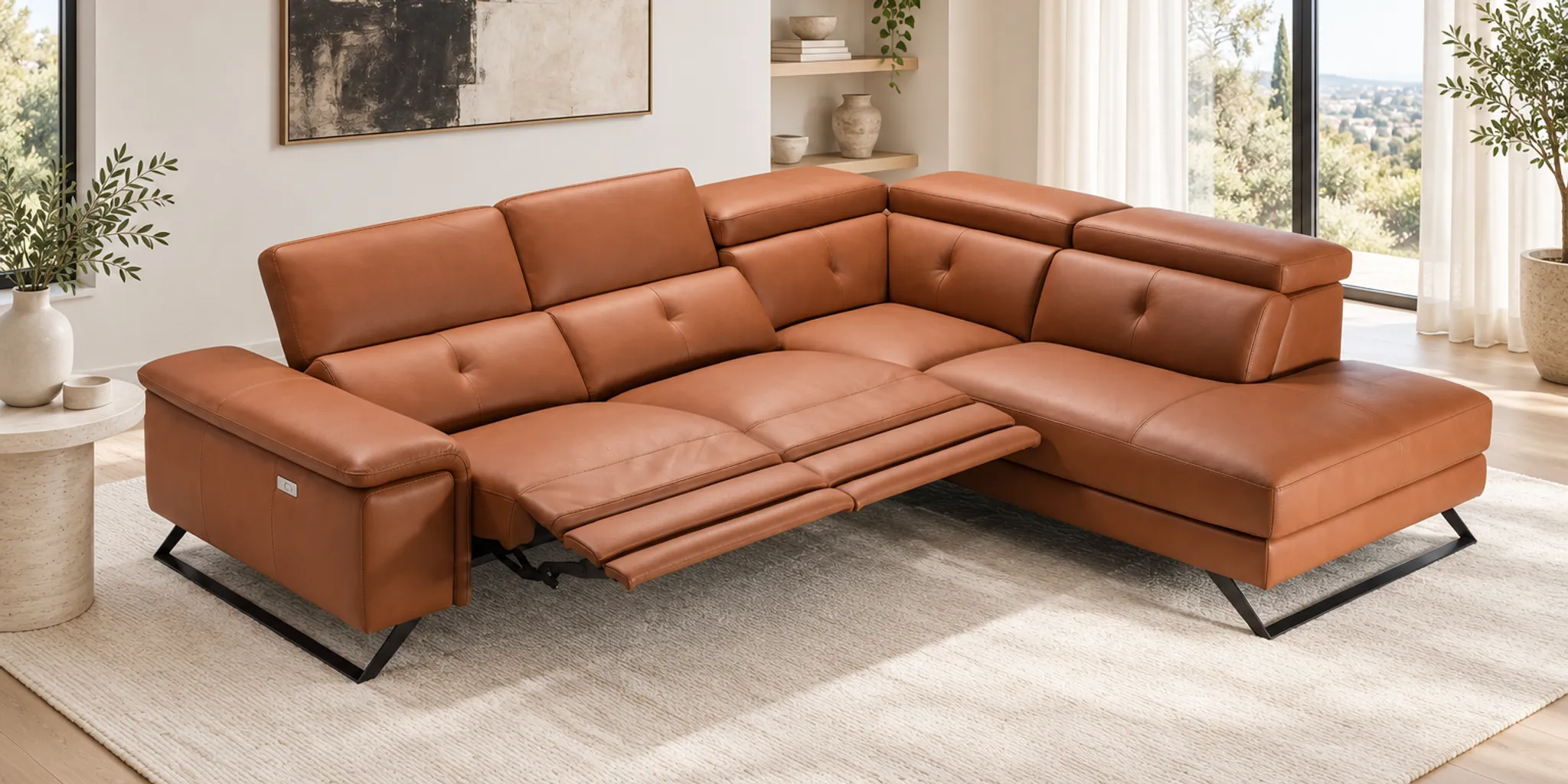
A leather sectional with recliner can be the most-used piece in a living room, yet it is also one of the easiest to misjudge. The right choice must support relaxed evenings without overwhelming the room, competing with the architecture, or making leather care feel like a chore. Start by evaluating the seating layout, closed and open positions, upholstery feel, mechanism, and visual proportion as one decision rather than shopping for features in isolation.
Book a design consultation to review your measurements, layout, and finish preferences with EuroHome before you commit.
A leather sectional with recliner works best when its connected seating, motion features, upholstery, and room proportions support the way your household actually lives. Compare those elements together, then confirm the fit with samples and a practical floor plan.
That approach clarifies whether this format suits your space and what to look for before you compare individual designs.
A leather sectional with recliner combines connected seating with one or more seats that extend or tilt into a reclining position. That combination changes more than the comfort level. You are choosing a room-scale layout, a tactile upholstery surface, and a moving mechanism at the same time. The best choice depends on how those three elements support the way your household actually sits, gathers, watches, reads, and entertains.
Connected seating can make a large room feel cohesive and give several people a shared place to relax. It can also limit flexibility: unlike separate chairs and sofas, a sectional is less simple to rearrange when the room changes. Reclining adds another practical question. Each seat needs enough usable space to move without disrupting a walkway, striking a table, or crowding a wall. A layout that looks generous when closed may feel significantly fuller when the footrests are extended.
Leather brings its own set of decisions. Its appearance, hand, finish, color, and visible seams contribute strongly to the room's character. Leather can read as tailored and architectural, but the wrong scale or finish may make a motion sectional feel heavier than intended. Look at upholstery samples in the room's natural and evening light, and consider whether the surface suits your household's habits before focusing on a particular silhouette.
This seating is often a strong fit for homeowners who want coordinated comfort without assembling a room from unrelated pieces. It may be less suitable when frequent furniture rearrangement, narrow circulation, or an especially light visual footprint matters more than integrated lounging. Start with European sofas and sectionals to understand the broader category, then compare the practical criteria rather than selecting by appearance alone. For feature-specific context, the guide to modern reclining sectional features can help, while this guide keeps the focus on leather, fit, and tradeoffs instead of ranking models.
Leather changes how a reclining sectional feels, looks, and lives in a room, so evaluate more than its color on a screen. Start with touch. A finish may feel smooth, supple, lightly textured, or more structured, and that first impression should suit how you expect to use the seating. If the sectional will anchor everyday family time, compare samples while considering bare skin, clothing, pets, and the amount of contact the cushions will receive.
View samples in the room where the sectional will live, ideally in both daylight and evening light. A warm brown can reinforce wood tones and traditional details, while a cooler gray or black may sharpen a contemporary setting. Also inspect how the finish reflects light. High sheen can make a large sectional feel more visually prominent; a quieter finish may integrate more softly with rugs, tables, and surrounding upholstery.
Ask to see the leather sample beside the actual frame or a representative finish board. Check whether the color is consistent with your flooring and wall paint, then look closely at grain, surface variation, and edge treatment. On a reclining sectional, seams and joins deserve particular attention because connected modules, moving seats, and corners can make upholstery lines more noticeable. The goal is not to eliminate every seam, but to understand how the pattern will read across the full composition.
Think honestly about traffic, meals, children, pets, sunlight, and the habits of the people who will use the room. Ask the retailer which cleaner and conditioner are appropriate for the specific leather finish, and whether a hidden-area test is recommended. Do not assume a familiar household product is safe. The Virginia Cooperative Extension upholstery guide advises considering upkeep before buying and includes dedicated guidance for leather and vinyl care.
Build simple maintenance into the decision. Follow the supplier's instructions, remove surface dust gently, and address spills promptly rather than allowing soil to accumulate. Ask whether cushion covers are intended to be removed or professionally cleaned; a zippered cover is not automatically suitable for home washing. The correct routine depends on the upholstery, so request written care guidance with the sample or quotation.
Keep your preferred samples in the room for several days. Sit beside them, place them near the windows, and compare them with the finishes already in your home. For more style context, explore these contemporary leather sectional styles. A thoughtful sample review helps you choose a leather sectional with recliner that feels comfortable in daily use and visually considered over time.
The right reclining system depends less on novelty than on how your household uses the room. For a leather sectional with recliner, the decision also affects cord placement, surrounding furniture, and how clearly the sectional reads as a considered part of the design. Manual and power options can both work well when matched to the room and the people using it.
Manual and power reclining considerations for a leather sectional
| Consideration | Manual reclining | Power reclining |
|---|---|---|
| User control | Offers a direct, usually simple adjustment that suits readers who prefer fewer controls. | Allows more gradual positioning, which can be useful when different household members have different comfort preferences. |
| Electrical planning | Does not require the same outlet and cord-planning questions, though the sectional still needs adequate clearance to move comfortably. | Requires the intended outlet location, cord path, and access for cleaning or rearranging to be considered before placement. |
| Household habits | Fits households that want occasional reclining without making it the visual or functional focus of the room. | Fits households that use the seating frequently for reading, television, conversation, or longer periods of relaxation. |
| Service questions | Ask how the moving parts can be inspected and what access is needed if adjustment becomes difficult. | Ask how the electrical components are accessed, what happens if power is interrupted, and how the controls are supported. |
| Visual integration | May feel visually restrained when the sectional is closed, supporting a cleaner composition in a formal living area. | Can provide fine positioning, but the layout should conceal or neatly manage cords and leave room for movement. |
Leather makes the choice especially tactile. If you want a straightforward seat that blends into a carefully styled room and reclining is occasional, manual may be the more natural fit. If precise positioning and repeated daily use matter, power may justify the additional planning. In either case, view the sectional closed as well as reclined. Check whether the arms, backs, and open footrests maintain a balanced silhouette with tables, rugs, and walkways. Ask the retailer to demonstrate the movement and explain routine care for the leather surface without assuming that every material or mechanism is maintained the same way.
Comfort does not have to dominate the room. A few deliberate choices can help a leather sectional with recliner read as tailored furniture rather than a single oversized block.
Look for a leg profile that creates a visible break between the upholstery and the floor. Slim, slightly raised legs allow more negative space beneath the seating, which can make the room feel lighter. This effect is especially useful when the sectional has broad arms or deep cushions. A low, solid base may feel grounded and substantial, but it can also make the entire composition appear heavier.
Proportion matters as much as scale. Balance a deep seat with visually delicate nearby pieces, such as a narrow side table, an open-base coffee table, or a floor lamp with a slender stem. Avoid placing a bulky table directly in front of the chaise or recliner. Keep the area around moving seats visually and physically open.
Dark leather can be elegant, but a large dark form draws attention. If the room already has dark flooring, cabinetry, or window treatments, consider a lighter leather tone or introduce contrast through a pale rug and warm wall color. A light leather sectional can also feel substantial, so do not rely on color alone. Repeating its tone in a lamp, artwork frame, or occasional chair helps it look intentional rather than visually isolated.
For a closer look at ways to coordinate color and finish, see EuroHome's guide to contemporary leather sectional styles. The goal is not to make the sectional disappear. It is to give the eye several places to rest.
A modular layout can reduce visual bulk by breaking up one long line. If the room allows it, a chaise can orient the seating toward the conversation area instead of pushing every element against a wall. Separate modules may also create clearer zones for conversation, reading, or viewing the room. Before committing, evaluate the sectional in both its upright and reclined positions so the open space remains useful throughout the day.
Finally, use lighting to distribute attention. A floor lamp beside the sofa, a wall light behind it, or a small table lamp on an adjacent surface can add vertical balance without adding another heavy shape. Thoughtful spacing, varied heights, and a controlled palette will make the seating feel comfortable and composed.
Before choosing a leather sectional with recliner, turn the showroom conversation into a practical checklist. The goal is not simply to confirm that the sofa looks right. It is to understand how it is built, how it will operate in your room, and what support you can expect after the order.
Care should be part of the purchase decision, not an afterthought. Virginia Cooperative Extension advises buyers to consider upkeep before selecting upholstered furniture and includes specific guidance for leather and vinyl care: review its upholstery care guidance. Ask which cleaning products, cloths, and professional services are appropriate for the actual leather finish. Do not assume that advice for one leather type applies to another.
Ask for these answers before committing, especially when comparing European sofas and sectionals. If measurements, electrical planning, or installation details are difficult to visualize, the EuroHome Design Center can help organize the decision around your room and the specific piece under consideration.
A leather sectional with recliner has to work in more than one position. It needs to look considered when the seats are upright, remain comfortable when the recliners are in use, and fit the room without disrupting circulation. A design consultation gives you a way to evaluate those decisions together instead of choosing upholstery, proportions, and motion features in isolation.
Begin with the room itself. EuroHome's space-planning process can help organize your measurements, sightlines, walkways, and the sectional's relationship to nearby tables, lighting, and media. Three-dimensional visualization can make the proposed arrangement easier to assess before you commit. It can also reveal where a substantial piece of furniture may need more breathing room or where another layout would create better balance.
Samples add another layer of confidence. Seeing leather color, surface character, and finish alongside your flooring, cabinetry, wall color, and existing furnishings is more useful than judging a small online image by itself. A focused conversation can narrow a broad European collection into a manageable set of directions that suit your home and your preferences. This does not imply that one sectional is right for every room.
EuroHome combines curated European sourcing with retail and interior design services. That means the conversation can include both the character you want and the practical questions that shape the installation. The conversation can cover everything from room planning through the next stages of the project. The EuroHome Design Center in King of Prussia, Pennsylvania, gives Greater Philadelphia-area shoppers a place to explore the design process in person.
Book a design consultation to review your room, samples, and leather sectional with recliner questions.
Comfort depends on more than cushion softness. Compare the seat depth, back support, footrest position, arm height, and the feel of the reclined position. If more than one person will use the sectional, test several positions and consider whether each seat supports the household's preferred way of relaxing. Room proportions matter too: a generously scaled piece may feel inviting in a large room but crowded in a tighter layout.
Ask for the care instructions for the exact upholstery before ordering, since finishes can require different products and methods. Plan for regular, gentle maintenance and prompt attention to spills rather than waiting for visible buildup. Virginia Cooperative Extension recommends considering upkeep before buying upholstered furniture and includes specific guidance for leather and vinyl care: review its upholstery care guide.
Measure the full footprint and map both the closed and fully reclined positions. Check traffic paths, door and stair access, nearby tables, sightlines, and the location of outlets if the system needs power. A scaled floor plan or visualization can reveal conflicts that a showroom impression misses. This is especially important when the sectional sits near a wall or serves as the room's main focal point.
Neither is universally better. Manual operation may suit buyers who prefer a simpler interaction and fewer electrical planning questions. Power operation can offer more controlled positioning, but it requires planning for outlets, cord routing, and household use. Ask how the mechanism operates, what space it needs, and how service would be handled before choosing.
Balance its visual weight with an appropriate room scale, open walkways, visible floor space, and lighter surrounding pieces. A slim leg profile, carefully chosen color, well-proportioned side tables, and layered lighting can keep the composition feeling intentional. Samples and a room visualization help you judge the sectional with your flooring, walls, and existing furnishings rather than evaluating the leather color in isolation.
A thoughtful consultation can help you compare room fit, leather samples, reclining preferences, and the visual balance of a cohesive European furniture plan. Bring your measurements, layout questions, and ideas for how you want the room to feel. Book a design consultation with EuroHome to review the details and move forward with greater confidence.


